Chapter 1 of 18
Arjuna Falls Apart
अर्जुनविषादयोगः
Arjuna-viṣāda Yoga · 47 verses
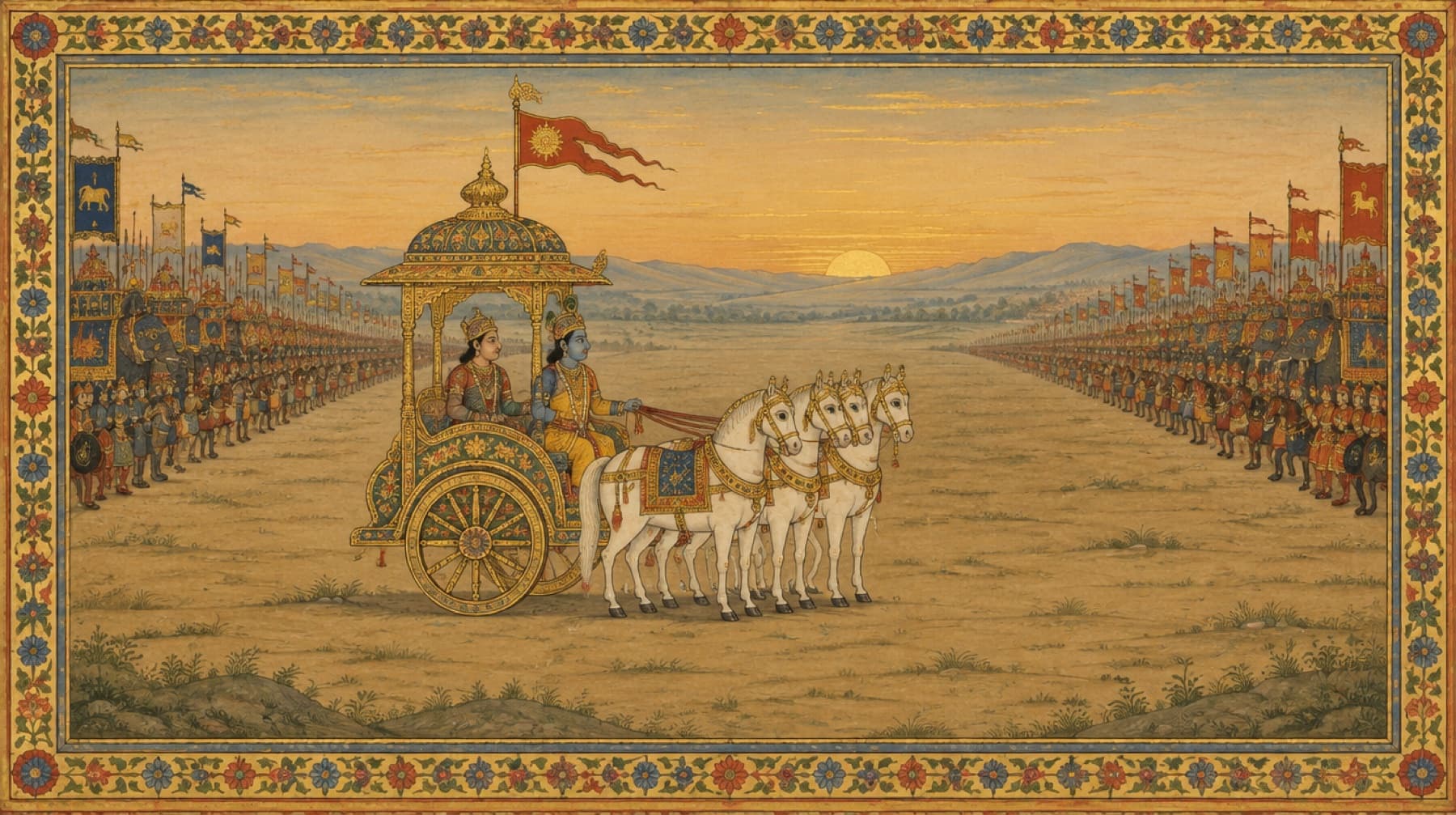
Two armies face each other. Arjuna asks his charioteer to drive him into the gap between them so he can see who he is about to fight. He looks, and he recognises everyone: his teachers, his cousins, the men who taught him to hold a bow. His body gives out. He puts down his weapon and sits down in the chariot.
Where this chapter leaves you
The Gita opens not with an answer but with a breakdown. By the end of this chapter nothing has been solved — a capable man has simply stopped being able to move. Everything that follows is the reply to this moment.
The verses
47 of 47 explained- 1
धर्मक्षेत्रे कुरुक्षेत्रे समवेता युयुत्सवः।मामकाः पाण्डवाश्चैव किमकुर्वत सञ्जय॥
Dhritarashtra said: On the field of dharma, at Kurukshetra, gathered and eager to fight — my men and the sons of Pandu — what did they do, Sanjaya?
The Gita opens with a question from a blind king.
Read the explanation → - 2
दृष्ट्वा तु पाण्डवानीकं व्यूढं दुर्योधनस्तदा।आचार्यमुपसङ्गम्य राजा वचनमब्रवीत्॥
Sanjaya said: Seeing the Pandava army drawn up in formation, King Duryodhana went to his teacher and spoke these words.
The war is about to start.
Read the explanation → - 3
पश्यैतां पाण्डुपुत्राणामाचार्य महतीं चमूम्।व्यूढां द्रुपदपुत्रेण तव शिष्येण धीमता॥
Look, teacher, at this great army of the sons of Pandu, drawn up by your own gifted student, the son of Drupada.
This sounds like a briefing.
Read the explanation → - 4
अत्र शूरा महेष्वासा भीमार्जुनसमा युधि।युयुधानो विराटश्च द्रुपदश्च महारथः॥
Here are heroes and great archers, the equals of Bhima and Arjuna in battle: Yuyudhana, Virata, and Drupada, the great warrior.
Duryodhana now starts listing the enemy.
Read the explanation → - 5
धृष्टकेतुश्चेकितानः काशिराजश्च वीर्यवान्।पुरुजित्कुन्तिभोजश्च शैब्यश्च नरपुङ्गवः॥
Dhrishtaketu, Chekitana, the brave king of Kashi, Purujit, Kuntibhoja, and Shaibya, the best of men.
The list goes on.
Read the explanation → - 6
युधामन्युश्च विक्रान्त उत्तमौजाश्च वीर्यवान्।सौभद्रो द्रौपदेयाश्च सर्व एव महारथाः॥
The mighty Yudhamanyu, the brave Uttamauja, the son of Subhadra, and the sons of Draupadi — every one of them a great warrior.
The last of the enemy names, and the ones that land hardest.
Read the explanation → - 7
अस्माकं तु विशिष्टा ये तान्निबोध द्विजोत्तम।नायका मम सैन्यस्य संज्ञार्थं तान्ब्रवीमि ते॥
But know too, best of the twice-born, who among us stands out — the leaders of my army. Let me name them for you.
Duryodhana turns at last to his own side.
Read the explanation → - 8
भवान्भीष्मश्च कर्णश्च कृपश्च समितिञ्जयः।अश्वत्थामा विकर्णश्च सौमदत्तिस्तथैव च॥
Yourself, and Bhishma, and Karna, and Kripa, victorious in war; Ashvatthama, Vikarna, and the son of Somadatta.
His own list, and it opens with the man standing in front of him.
Read the explanation → - 9
अन्ये च बहवः शूरा मदर्थे त्यक्तजीविताः।नानाशस्त्रप्रहरणाः सर्वे युद्धविशारदाः॥
And many other heroes besides, ready to give up their lives for my sake, armed with every kind of weapon, all of them skilled in war.
He finishes his own list without finishing it.
Read the explanation → - 10
अपर्याप्तं तदस्माकं बलं भीष्माभिरक्षितम्।पर्याप्तं त्विदमेतेषां बलं भीमाभिरक्षितम्॥
Our strength, guarded by Bhishma, is beyond measure; their strength, guarded by Bhima, is easy to measure.
Duryodhana's conclusion: we are stronger.
Read the explanation → - 11
अयनेषु च सर्वेषु यथाभागमवस्थिताः।भीष्ममेवाभिरक्षन्तु भवन्तः सर्व एव हि॥
So all of you, holding your assigned positions at every point in the line, protect Bhishma above all.
And here is his actual order, after all that talk: guard the old man.
Read the explanation → - 12
तस्य संजनयन्हर्षं कुरुवृद्धः पितामहः।सिंहनादं विनद्योच्चैः शङ्खं दध्मौ प्रतापवान्॥
Then the mighty elder of the Kurus, the grandfather Bhishma, roared like a lion and blew his conch, filling Duryodhana with joy.
Bhishma answers without a word.
Read the explanation → - 13
ततः शङ्खाश्च भेर्यश्च पणवानकगोमुखाः।सहसैवाभ्यहन्यन्त स शब्दस्तुमुलोऽभवत्॥
Then conches and kettledrums, tabors, drums and horns suddenly blared out, and the sound was a tumult.
The whole army answers at once.
Read the explanation → - 14
ततः श्वेतैर्हयैर्युक्ते महति स्यन्दने स्थितौ।माधवः पाण्डवश्चैव दिव्यौ शङ्खौ प्रदध्मतुः॥
Then, standing in their great chariot yoked with white horses, Krishna and Arjuna blew their divine conches.
The other side answers.
Read the explanation → - 15
पाञ्चजन्यं हृषीकेशो देवदत्तं धनंजयः।पौण्ड्रं दध्मौ महाशङ्खं भीमकर्मा वृकोदरः॥
Krishna blew Panchajanya, Arjuna blew Devadatta, and Bhima of terrible deeds blew his great conch Paundra.
The conches have names, the way swords have names in other epics.
Read the explanation → - 16
अनन्तविजयं राजा कुन्तीपुत्रो युधिष्ठिरः।नकुलः सहदेवश्च सुघोषमणिपुष्पकौ॥
King Yudhishthira, son of Kunti, blew Anantavijaya; Nakula and Sahadeva blew Sughosha and Manipushpaka.
The three remaining brothers sound theirs.
Read the explanation → - 17
काश्यश्च परमेष्वासः शिखण्डी च महारथः।धृष्टद्युम्नो विराटश्च सात्यकिश्चापराजितः॥
The king of Kashi, that great archer; Shikhandi, the mighty warrior; Dhrishtadyumna, Virata, and Satyaki, who has never been beaten.
The allies join in.
Read the explanation → - 18
द्रुपदो द्रौपदेयाश्च सर्वशः पृथिवीपते।सौभद्रश्च महाबाहुः शङ्खान्दध्मुः पृथक्पृथक्॥
Drupada, the sons of Draupadi, and the strong-armed son of Subhadra — each of them, lord of the earth, blew his own conch.
The list closes with the young ones.
Read the explanation → - 19
स घोषो धार्तराष्ट्राणां हृदयानि व्यदारयत्।नभश्च पृथिवीं चैव तुमुलो व्यनुनादयन्॥
That tumult, thundering through earth and sky, tore the hearts of Dhritarashtra's sons.
The sound does damage before a single arrow is fired.
Read the explanation → - 20
अथ व्यवस्थितान् दृष्ट्वा धार्तराष्ट्रान्कपिध्वजः।प्रवृत्ते शस्त्रसंपाते धनुरुद्यम्य पाण्डवः॥
Then, seeing Dhritarashtra's men drawn up and the weapons about to fly, Arjuna, whose banner bears the monkey, raised his bow and spoke to Krishna.
Arjuna is ready.
Read the explanation → - 21
हृषीकेशं तदा वाक्यमिदमाह महीपते।सेनयोरुभयोर्मध्ये रथं स्थापय मेऽच्युत॥
Arjuna said: Krishna, halt my chariot between the two armies.
Here is the request that changes everything, and it is four words long.
Read the explanation → - 22
यावदेतान्निरीक्षेऽहं योद्धुकामानवस्थितान्।कैर्मया सह योद्धव्यमस्मिन्रणसमुद्यमे॥
Let me look at these men standing here, wanting to fight — the ones I must face in this work of war.
He gives his reason: he wants to look at them.
Read the explanation → - 23
योत्स्यमानानवेक्षेऽहं य एतेऽत्र समागताः।धार्तराष्ट्रस्य दुर्बुद्धेर्युद्धे प्रियचिकीर्षवः॥
Let me see those who have gathered here to fight, eager to do what pleases the wicked-minded son of Dhritarashtra.
One flash of anger.
Read the explanation → - 24
एवमुक्तो हृषीकेशो गुडाकेशेन भारत।सेनयोरुभयोर्मध्ये स्थापयित्वा रथोत्तमम्॥
Sanjaya said: Asked in this way by Arjuna, Krishna halted that splendid chariot between the two armies.
Krishna does it.
Read the explanation → - 25
भीष्मद्रोणप्रमुखतः सर्वेषां च महीक्षिताम्।उवाच पार्थ पश्यैतान्समवेतान्कुरूनिति॥
There, in front of Bhishma and Drona and all the kings of the earth, he said: Partha, behold these Kurus gathered here.
Krishna parks the chariot directly in front of the two men Arjuna loves most on that side, and says nine words.
Read the explanation → - 26
तत्रापश्यत्स्थितान्पार्थः पितॄनथ पितामहान् ।आचार्यान्मातुलान्भ्रातॄन्पुत्रान्पौत्रान्सखींस्तथा॥
And there Arjuna saw, standing in both armies: fathers, grandfathers, teachers, uncles, brothers, sons, grandsons, companions, fathers-in-law and friends.
He looks.
Read the explanation → - 27
श्वशुरान्सुहृदश्चैव सेनयोरुभयोरपि।तान्समीक्ष्य स कौन्तेयः सर्वान्बन्धूनवस्थितान्॥
Seeing all these kinsmen standing there, the son of Kunti was overcome with deep pity, and in sorrow he said this.
And he breaks.
Read the explanation → - 28
कृपया परयाऽऽविष्टो विषीदन्निदमब्रवीत्।दृष्ट्वेमं स्वजनं कृष्ण युयुत्सुं समुपस्थितम्॥
Arjuna said: Krishna, seeing my own people standing here wanting to fight,
He speaks for the first time since asking to be driven forward, and the sentence does not finish.
Read the explanation → - 29
सीदन्ति मम गात्राणि मुखं च परिशुष्यति।वेपथुश्च शरीरे मे रोमहर्षश्च जायते॥
my limbs give way, my mouth goes dry, my body shakes, my hair stands on end.
This is not a metaphor.
Read the explanation → - 30
गाण्डीवं स्रंसते हस्तात्त्वक्चैव परिदह्यते।न च शक्नोम्यवस्थातुं भ्रमतीव च मे मनः॥
Gandiva slips from my hand, my skin is burning, I cannot keep standing, and my mind is reeling.
The bow falls out of his grip.
Read the explanation → - 31
निमित्तानि च पश्यामि विपरीतानि केशव।न च श्रेयोऽनुपश्यामि हत्वा स्वजनमाहवे॥
And I see omens against us, Krishna. I see no good in killing my own people in battle.
Now he starts reasoning, and the reasoning is thin.
Read the explanation → - 32
न काङ्क्षे विजयं कृष्ण न च राज्यं सुखानि च।किं नो राज्येन गोविन्द किं भोगैर्जीवितेन वा॥
I want no victory, Krishna, no kingdom, no pleasures. What is a kingdom to us, what are enjoyments, or life itself?
He gives up the prize.
Read the explanation → - 33
येषामर्थे काङ्क्षितं नो राज्यं भोगाः सुखानि च।त इमेऽवस्थिता युद्धे प्राणांस्त्यक्त्वा धनानि च॥
Those for whose sake we want kingdom, comforts and pleasures — they are standing here in battle, giving up their lives and their wealth.
Here is his strongest argument, and it is a good one.
Read the explanation → - 34
आचार्याः पितरः पुत्रास्तथैव च पितामहाः ।मातुलाः श्वशुराः पौत्राः श्यालाः सम्बन्धिनस्तथा॥
Teachers, fathers, sons, grandfathers, uncles, fathers-in-law, grandsons, brothers-in-law and kinsmen —
He lists them again.
Read the explanation → - 35
एतान्न हन्तुमिच्छामि घ्नतोऽपि मधुसूदन।अपि त्रैलोक्यराज्यस्य हेतोः किं नु महीकृते॥
I do not wish to kill them, Krishna, even if they kill me — not for lordship over the three worlds, let alone for this earth.
He would rather die than fight them.
Read the explanation → - 36
निहत्य धार्तराष्ट्रान्नः का प्रीतिः स्याज्जनार्दन।पापमेवाश्रयेदस्मान्हत्वैतानाततायिनः॥
What joy could there be for us, Krishna, in killing Dhritarashtra's sons? Killing these aggressors would only bring guilt upon us.
Notice the word he uses for them: ātatāyinaḥ, aggressors.
Read the explanation → - 37
तस्मान्नार्हा वयं हन्तुं धार्तराष्ट्रान्स्वबान्धवान्।स्वजनं हि कथं हत्वा सुखिनः स्याम माधव॥
So we ought not to kill Dhritarashtra's sons, our own kinsmen. How could we be happy, Krishna, after killing our own people?
He concludes, and then immediately re-opens the question.
Read the explanation → - 38
यद्यप्येते न पश्यन्ति लोभोपहतचेतसः।कुलक्षयकृतं दोषं मित्रद्रोहे च पातकम्॥
Even if these men, their minds overcome by greed, see no fault in destroying a family, no crime in betraying a friend —
Here his tone changes.
Read the explanation → - 39
कथं न ज्ञेयमस्माभिः पापादस्मान्निवर्तितुम्।कुलक्षयकृतं दोषं प्रपश्यद्भिर्जनार्दन॥
— why should we not know better than to turn back from this crime, Krishna, we who do see the fault in destroying a family?
They cannot see it, he says.
Read the explanation → - 40
कुलक्षये प्रणश्यन्ति कुलधर्माः सनातनाः।धर्मे नष्टे कुलं कृत्स्नमधर्मोऽभिभवत्युत॥
When a family is destroyed, its ancient traditions perish; and when tradition is gone, lawlessness overtakes the whole family.
Now something changes in how he is talking.
Read the explanation → - 41
अधर्माभिभवात्कृष्ण प्रदुष्यन्ति कुलस्त्रियः।स्त्रीषु दुष्टासु वार्ष्णेय जायते वर्णसङ्करः॥
When lawlessness prevails, Krishna, the women of the family are corrupted; and when women are corrupted, the mixing of social orders follows.
This verse says that social collapse works through women, and that the result is the blurring of caste boundaries.
Read the explanation → - 42
सङ्करो नरकायैव कुलघ्नानां कुलस्य च।पतन्ति पितरो ह्येषां लुप्तपिण्डोदकक्रियाः॥
That mixing brings only hell for the family and for those who destroy it. Their ancestors fall, deprived of their offerings of rice and water.
The argument reaches the dead.
Read the explanation → - 43
दोषैरेतैः कुलघ्नानां वर्णसङ्करकारकैः।उत्साद्यन्ते जातिधर्माः कुलधर्माश्च शाश्वताः॥
By the misdeeds of those who destroy a family and cause this mixing, the ancient duties of community and household are wiped out.
He repeats himself.
Read the explanation → - 44
उत्सन्नकुलधर्माणां मनुष्याणां जनार्दन।नरकेऽनियतं वासो भवतीत्यनुशुश्रुम॥
And we have heard, Krishna, that those whose household duties are destroyed dwell in hell for as long as anyone knows.
And there it is: *we have heard.* After five verses of confident doctrine, he attributes the whole thing.
Read the explanation → - 45
अहो बत महत्पापं कर्तुं व्यवसिता वयम्।यद्राज्यसुखलोभेन हन्तुं स्वजनमुद्यताः॥
Alas — we have set our minds on a great crime, ready to kill our own people out of greed for the pleasures of a kingdom.
The doctrine drops away and his own voice comes back.
Read the explanation → - 46
यदि मामप्रतीकारमशस्त्रं शस्त्रपाणयः।धार्तराष्ट्रा रणे हन्युस्तन्मे क्षेमतरं भवेत्॥
It would be better for me if Dhritarashtra's men, weapons in hand, killed me in battle unarmed and unresisting.
His last words in this chapter.
Read the explanation → - 47
एवमुक्त्वाऽर्जुनः संख्ये रथोपस्थ उपाविशत्।विसृज्य सशरं चापं शोकसंविग्नमानसः॥
Sanjaya said: Having spoken so, Arjuna sank down on the seat of the chariot in the middle of the battle, letting go of his bow and arrows, his mind overwhelmed with grief.
He sits down.
Read the explanation →