Chapter 8 of 18
What Does Not Perish
अक्षरब्रह्मयोगः
Akṣara-brahma Yoga · 28 verses
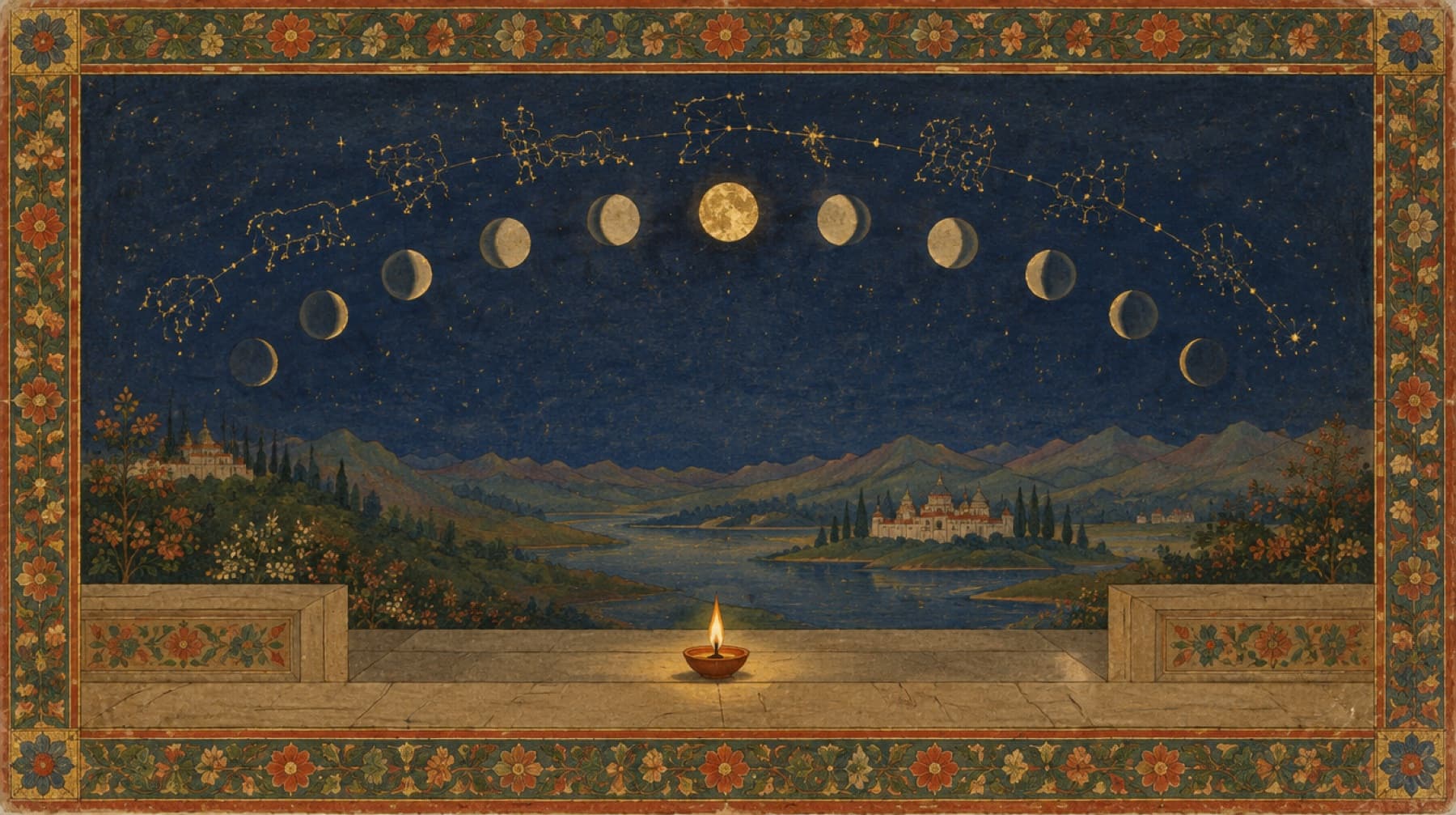
Arjuna asks a run of direct questions about what lasts, what dies, and what happens at the end. Krishna answers with the long view: vast cycles of time, and what the mind turns to in its final moment.
Where this chapter leaves you
The scale widens past a single life. Death stops being the end of the argument and becomes part of a much longer rhythm.
The verses
28 / 28 explainedChapter 8 · Verse 1
किं तद्ब्रह्म किमध्यात्मं किं कर्म पुरुषोत्तम।अधिभूतं च किं प्रोक्तमधिदैवं किमुच्यते॥
Arjuna said: What is that Brahman? What is the self? What is action? What is called the ground of matter, and what is called the ground of the gods?
Krishna ended the last chapter with three technical words and walked straight past them.
Read the explanationChapter 8 · Verse 2
अधियज्ञः कथं कोऽत्र देहेऽस्मिन्मधुसूदन।प्रयाणकाले च कथं ज्ञेयोऽसि नियतात्मभिः॥
Who is the ground of sacrifice, here in this body, Krishna? And at the hour of leaving, how are you to be known by those who have steadied themselves?
The second question is the one he actually cares about.
Read the explanationChapter 8 · Verse 3
अक्षरं ब्रह्म परमं स्वभावोऽध्यात्ममुच्यते।भूतभावोद्भवकरो विसर्गः कर्मसंज्ञितः॥
Krishna said: The imperishable, the highest, is Brahman. Its own being, in each person, is called the self. And the sending-forth that brings beings into existence is called action.
Three answers, packed tight.
Read the explanationChapter 8 · Verse 4
अधिभूतं क्षरो भावः पुरुषश्चाधिदैवतम्।अधियज्ञोऽहमेवात्र देहे देहभृतां वर॥
The ground of matter is the perishable nature. The ground of the gods is the cosmic person. And the ground of sacrifice is myself, here, in this body, best of the embodied.
Two more answers, and then the one that lands somewhere unexpected.
Read the explanationChapter 8 · Verse 5
अन्तकाले च मामेव स्मरन्मुक्त्वा कलेवरम्।यः प्रयाति स मद्भावं याति नास्त्यत्र संशयः॥
And whoever leaves the body at the very end while remembering me alone, goes to my own nature. Of this there is no doubt.
This is the verse that has been used to frighten people, so read what it actually says.
Read the explanationChapter 8 · Verse 6
यं यं वापि स्मरन्भावं त्यजत्यन्ते कलेवरम्।तं तमेवैति कौन्तेय सदा तद्भावभावितः॥
Whatever state a person is remembering as he lets go of the body at the end - that is the state he goes to, having been shaped by it all along.
The second half of the line is the key to the whole passage.
Read the explanationChapter 8 · Verse 7
तस्मात्सर्वेषु कालेषु मामनुस्मर युध्य च।मय्यर्पितमनोबुद्धिर्मामेवैष्यस्यसंशयम्॥
So remember me at all times - and fight. With your mind and your reason given over to me, you will come to me. Have no doubt about it.
Here is the practical conclusion, and look at the second instruction.
Read the explanationChapter 8 · Verse 8
अभ्यासयोगयुक्तेन चेतसा नान्यगामिना।परमं पुरुषं दिव्यं याति पार्थानुचिन्तयन्॥
With a mind trained by steady practice, not wandering off elsewhere, thinking of him again and again - one reaches the supreme divine person, Arjuna.
Abhyāsa - practice.
Read the explanationChapter 8 · Verse 9
कविं पुराणमनुशासितार मणोरणीयांसमनुस्मरेद्यः।सर्वस्य धातारमचिन्त्यरूप मादित्यवर्णं तमसः परस्तात्॥
One who keeps in mind the ancient seer, the one who orders all things, smaller than the smallest, the holder of everything, whose form thought cannot reach, shining like the sun, beyond the dark…
A run of descriptions that will not sit together.
Read the explanationChapter 8 · Verse 10
प्रयाणकाले मनसाऽचलेन भक्त्या युक्तो योगबलेन चैव।भ्रुवोर्मध्ये प्राणमावेश्य सम्यक् स तं परं पुरुषमुपैति दिव्यम्॥
At the hour of leaving, with a steady mind, joined by devotion and by the strength that practice gives, settling the breath between the brows - he reaches that supreme divine person.
A piece of technique appears, and it is genuine yogic instruction: breath drawn to a point between the eyebrows.
Read the explanationChapter 8 · Verse 11
यदक्षरं वेदविदो वदन्ति विशन्ति यद्यतयो वीतरागाः।यदिच्छन्तो ब्रह्मचर्यं चरन्ति तत्ते पदं संग्रहेण प्रवक्ष्ये॥
That state which those who know the Vedas call imperishable, which the self-controlled enter once craving has gone, wanting which people live a disciplined life - that goal I will tell you in brief.
Three different groups are named, with three different vocabularies.
Read the explanationChapter 8 · Verse 12
सर्वद्वाराणि संयम्य मनो हृदि निरुध्य च।मूर्ध्न्याधायात्मनः प्राणमास्थितो योगधारणाम्॥
Closing all the gates, holding the mind in the heart, drawing the breath up into the head, settled in the hold of yoga…
The gates are the senses.
Read the explanationChapter 8 · Verse 13
ओमित्येकाक्षरं ब्रह्म व्याहरन्मामनुस्मरन्।यः प्रयाति त्यजन्देहं स याति परमां गतिम्॥
Saying Om, the single syllable that is Brahman, keeping me in mind - whoever leaves, giving up the body, goes the highest way.
After the technique, one syllable.
Read the explanationChapter 8 · Verse 14
अनन्यचेताः सततं यो मां स्मरति नित्यशः।तस्याहं सुलभः पार्थ नित्ययुक्तस्य योगिनः॥
For the one who remembers me constantly, whose mind goes nowhere else - for that practitioner, always joined, I am easy to reach.
Sulabhaḥ - easy to reach.
Read the explanationChapter 8 · Verse 15
मामुपेत्य पुनर्जन्म दुःखालयमशाश्वतम्।नाप्नुवन्ति महात्मानः संसिद्धिं परमां गताः॥
Having come to me, the great souls who have reached the highest completion are not born again into this impermanent house of sorrow.
Duḥkhālayam - house of sorrow.
Read the explanationChapter 8 · Verse 16
आब्रह्मभुवनाल्लोकाः पुनरावर्तिनोऽर्जुन।मामुपेत्य तु कौन्तेय पुनर्जन्म न विद्यते॥
All the worlds, right up to the world of Brahmā, come round again, Arjuna. But having reached me, there is no being born again.
Even heaven runs out.
Read the explanationChapter 8 · Verse 17
सहस्रयुगपर्यन्तमहर्यद्ब्रह्मणो विदुः।रात्रिं युगसहस्रान्तां तेऽहोरात्रविदो जनाः॥
Those who understand know that a day of Brahmā lasts a thousand ages, and that his night also ends only after a thousand ages.
The scale opens up without warning.
Read the explanationChapter 8 · Verse 18
अव्यक्ताद्व्यक्तयः सर्वाः प्रभवन्त्यहरागमे।रात्र्यागमे प्रलीयन्ते तत्रैवाव्यक्तसंज्ञके॥
At the coming of day, all manifest things appear out of the unmanifest. At the coming of night they dissolve back into that same unmanifest.
Appearing and dissolving, described as a rhythm.
Read the explanationChapter 8 · Verse 19
भूतग्रामः स एवायं भूत्वा भूत्वा प्रलीयते।रात्र्यागमेऽवशः पार्थ प्रभवत्यहरागमे॥
This same crowd of beings comes into being again and again, and dissolves, helplessly, when night comes - and comes forth again when day comes.
Avaśaḥ - helpless.
Read the explanationChapter 8 · Verse 20
परस्तस्मात्तु भावोऽन्योऽव्यक्तोऽव्यक्तात्सनातनः।यः स सर्वेषु भूतेषु नश्यत्सु न विनश्यति॥
Beyond that unmanifest is another unmanifest, older, which does not perish when all beings perish.
Two unmanifests, and the difference matters.
Read the explanationChapter 8 · Verse 21
अव्यक्तोऽक्षर इत्युक्तस्तमाहुः परमां गतिम्।यं प्राप्य न निवर्तन्ते तद्धाम परमं मम॥
That unmanifest, called imperishable, is spoken of as the highest goal. Reaching it, they do not return. That is my highest home.
After all the abstraction, one homely word.
Read the explanationChapter 8 · Verse 22
पुरुषः स परः पार्थ भक्त्या लभ्यस्त्वनन्यया।यस्यान्तःस्थानि भूतानि येन सर्वमिदं ततम्॥
That supreme person, within whom all beings rest and by whom all this is spread out, is reached by devotion given to him and to nothing else.
Here is the method, finally stated.
Read the explanationChapter 8 · Verse 23
यत्र काले त्वनावृत्तिमावृत्तिं चैव योगिनः।प्रयाता यान्ति तं कालं वक्ष्यामि भरतर्षभ॥
I will tell you, Arjuna, the times at which practitioners who depart do not return, and the times at which they do.
What follows is old cosmology, and it is honest to say so.
Read the explanationChapter 8 · Verse 24
अग्निर्ज्योतिरहः शुक्लः षण्मासा उत्तरायणम्।तत्र प्रयाता गच्छन्ति ब्रह्म ब्रह्मविदो जनाः॥
Fire, light, day, the bright half of the month, the six months of the sun's northern course - those who depart then, knowing Brahman, go to Brahman.
Every item on this list is something that shows you where you are.
Read the explanationChapter 8 · Verse 25
धूमो रात्रिस्तथा कृष्णः षण्मासा दक्षिणायनम्।तत्र चान्द्रमसं ज्योतिर्योगी प्राप्य निवर्तते॥
Smoke, night, the dark half of the month, the six months of the sun's southern course - departing then, the practitioner reaches the light of the moon and returns.
The other route, made of things that obscure: smoke, night, the waning moon.
Read the explanationChapter 8 · Verse 26
शुक्लकृष्णे गती ह्येते जगतः शाश्वते मते।एकया यात्यनावृत्तिमन्ययाऽऽवर्तते पुनः॥
These two, the bright and the dark, are held to be the world's lasting paths. By the one a person goes without returning; by the other, he comes back again.
The two paths are called śāśvate - lasting, permanent features of how things work.
Read the explanationChapter 8 · Verse 27
नैते सृती पार्थ जानन्योगी मुह्यति कश्चन।तस्मात्सर्वेषु कालेषु योगयुक्तो भवार्जुन॥
Knowing these two paths, Arjuna, no practitioner is confused by them. So at all times, be joined.
And there it is.
Read the explanationChapter 8 · Verse 28
वेदेषु यज्ञेषु तपःसु चैव दानेषु यत्पुण्यफलं प्रदिष्टम्।अत्येति तत्सर्वमिदं विदित्वा योगी परं स्थानमुपैति चाद्यम्॥
Knowing all this, the practitioner goes past whatever merit is promised for study of the Vedas, for sacrifices, for austerities and for gifts - and reaches the first and highest place.
A closing comparison, and a bold one.
Read the explanation