Chapter 9 of 18
The Open Secret
राजविद्याराजगुह्ययोगः
Rāja-vidyā-rāja-guhya Yoga · 34 verses
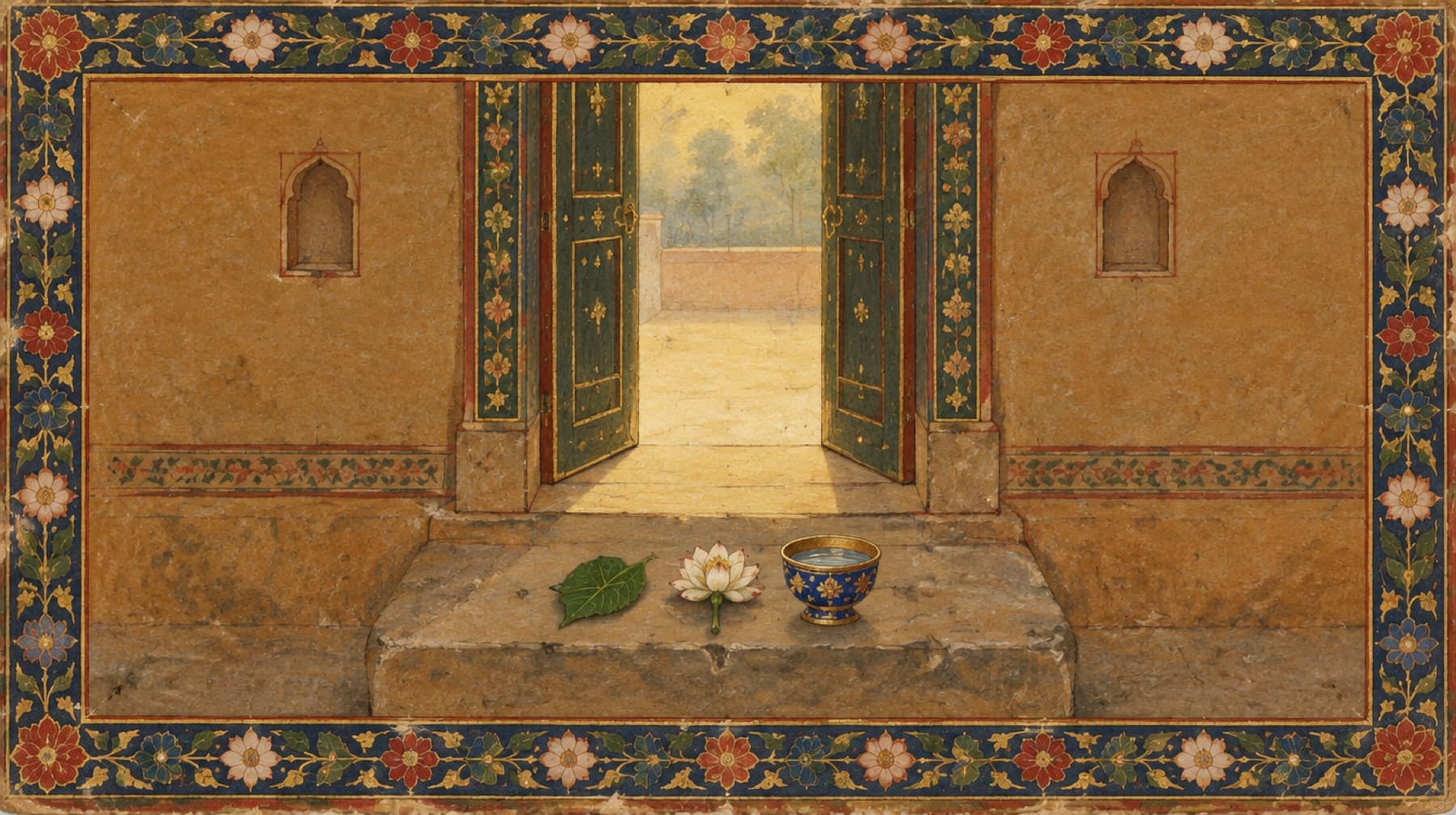
Krishna calls this the most direct teaching of all, and the most freely given. Everything rests in him without him being caught up in it. And the door is open to anyone at all - a leaf, a flower, water offered honestly is enough.
Where this chapter leaves you
The most inclusive chapter in the book. Access stops depending on birth, learning, or ritual and starts depending on sincerity.
The verses
34 / 34 explainedChapter 9 · Verse 1
इदं तु ते गुह्यतमं प्रवक्ष्याम्यनसूयवे।ज्ञानं विज्ञानसहितं यज्ज्ञात्वा मोक्ष्यसेऽशुभात्॥
Krishna said: To you, who do not sneer at it, I shall tell this most secret thing - knowledge together with the realising of it, knowing which you will be free of what is unlovely.
There is one condition, and it is not what you would expect.
Read the explanationChapter 9 · Verse 2
राजविद्या राजगुह्यं पवित्रमिदमुत्तमम्।प्रत्यक्षावगमं धर्म्यं सुसुखं कर्तुमव्ययम्॥
This is the king of knowledge, the king of secrets, the purest, the highest. It can be seen directly. It agrees with what is right, it is very easy to practise, and it does not wear out.
Five claims in one line, and the strange one is in the middle.
Read the explanationChapter 9 · Verse 3
अश्रद्दधानाः पुरुषा धर्मस्यास्य परन्तप।अप्राप्य मां निवर्तन्ते मृत्युसंसारवर्त्मनि॥
People who will not put their weight on this teaching do not reach me, Arjuna. They come back, onto the road of dying and being born again.
Aśraddadhānāḥ - without śraddhā.
Read the explanationChapter 9 · Verse 4
मया ततमिदं सर्वं जगदव्यक्तमूर्तिना।मत्स्थानि सर्वभूतानि न चाहं तेष्ववस्थितः॥
All this world is spread out by me, in a form that does not appear. All beings rest in me, and I do not rest in them.
Two halves, and the second one is deliberate.
Read the explanationChapter 9 · Verse 5
न च मत्स्थानि भूतानि पश्य मे योगमैश्वरम्।भूतभृन्न च भूतस्थो ममात्मा भूतभावनः॥
And beings do not rest in me. Look at the power of my joining. Holding beings up and not standing in them, my very self is what brings beings into being.
He has just said all beings rest in him.
Read the explanationChapter 9 · Verse 6
यथाऽऽकाशस्थितो नित्यं वायुः सर्वत्रगो महान्।तथा सर्वाणि भूतानि मत्स्थानीत्युपधारय॥
As the mighty wind, going everywhere, always rests in space - know that in the same way all beings rest in me.
One image, and the confusion of the last two verses settles.
Read the explanationChapter 9 · Verse 7
सर्वभूतानि कौन्तेय प्रकृतिं यान्ति मामिकाम्।कल्पक्षये पुनस्तानि कल्पादौ विसृजाम्यहम्॥
All beings go into my nature at the end of an age, Arjuna. And at the beginning of the next age, I send them out again.
The cycle, stated without drama.
Read the explanationChapter 9 · Verse 8
प्रकृतिं स्वामवष्टभ्य विसृजामि पुनः पुनः।भूतग्राममिमं कृत्स्नमवशं प्रकृतेर्वशात्॥
Presiding over my own nature, I send out again and again this whole crowd of beings - helpless, under the force of nature.
Avaśam - helpless, without a say.
Read the explanationChapter 9 · Verse 9
न च मां तानि कर्माणि निबध्नन्ति धनञ्जय।उदासीनवदासीनमसक्तं तेषु कर्मसु॥
And these actions do not bind me, Arjuna. I sit as if uninvolved, not caught in those actions.
Udāsīna-vat - as if indifferent.
Read the explanationChapter 9 · Verse 10
मयाऽध्यक्षेण प्रकृतिः सूयते सचराचरम्।हेतुनाऽनेन कौन्तेय जगद्विपरिवर्तते॥
With me as the one overseeing it, nature gives birth to everything that moves and everything that does not. That is the reason, Arjuna, that the world turns.
Adhyakṣa - the one who watches over.
Read the explanationChapter 9 · Verse 11
अवजानन्ति मां मूढा मानुषीं तनुमाश्रितम्।परं भावमजानन्तो मम भूतमहेश्वरम्॥
The foolish look down on me when I take a human form, not knowing my higher nature as the great lord of all beings.
The complaint is about dismissal, and about what causes it.
Read the explanationChapter 9 · Verse 12
मोघाशा मोघकर्माणो मोघज्ञाना विचेतसः।राक्षसीमासुरीं चैव प्रकृतिं मोहिनीं श्रिताः॥
Their hopes come to nothing, their actions come to nothing, their knowledge comes to nothing. They have no sense, and they have taken up a nature that is cruel and grasping and misleading.
Mogha three times over: empty, in vain, wasted.
Read the explanationChapter 9 · Verse 13
महात्मानस्तु मां पार्थ दैवीं प्रकृतिमाश्रिताः।भजन्त्यनन्यमनसो ज्ञात्वा भूतादिमव्ययम्॥
But the great souls, Arjuna, taking refuge in the divine nature, worship me with undivided mind, knowing me as the imperishable origin of beings.
The counterweight arrives immediately.
Read the explanationChapter 9 · Verse 14
सततं कीर्तयन्तो मां यतन्तश्च दृढव्रताः।नमस्यन्तश्च मां भक्त्या नित्ययुक्ता उपासते॥
Always speaking of me, striving, firm in what they have undertaken, bowing to me with love, always joined - so they worship.
Four things, all of them physical: speaking, striving, holding to a vow, bowing.
Read the explanationChapter 9 · Verse 15
ज्ञानयज्ञेन चाप्यन्ये यजन्तो मामुपासते।एकत्वेन पृथक्त्वेन बहुधा विश्वतोमुखम्॥
And others worship me by offering knowledge itself - as one, or as many, or as facing in every direction.
Three quite different pictures of God, listed in one line.
Read the explanationChapter 9 · Verse 16
अहं क्रतुरहं यज्ञः स्वधाऽहमहमौषधम्।मंत्रोऽहमहमेवाज्यमहमग्निरहं हुतम्॥
I am the rite and I am the sacrifice. I am the offering made to the ancestors, and the healing herb. I am the sacred words, I am the butter, I am the fire, and I am the offering itself.
Every role in the ceremony, claimed at once.
Read the explanationChapter 9 · Verse 17
पिताऽहमस्य जगतो माता धाता पितामहः।वेद्यं पवित्रमोंकार ऋक् साम यजुरेव च॥
I am the father of this world, and the mother, and the one who holds it, and the grandfather. I am what is to be known, the purifier, the syllable Om, and the three Vedas.
Mother is in the list, in the same breath as father, with nothing marking it as unusual.
Read the explanationChapter 9 · Verse 18
गतिर्भर्ता प्रभुः साक्षी निवासः शरणं सुहृत्।प्रभवः प्रलयः स्थानं निधानं बीजमव्ययम्॥
The goal, the one who holds you up, the lord, the witness, the dwelling, the refuge, the friend. The coming into being and the passing away, the ground, the resting place, the seed that does not perish.
Twelve words, and eleven of them are what you would expect.
Read the explanationChapter 9 · Verse 19
तपाम्यहमहं वर्षं निगृह्णाम्युत्सृजामि च।अमृतं चैव मृत्युश्च सदसच्चाहमर्जुन॥
I give the heat. I hold back the rain and I send it. I am what does not die, and I am the ending too, Arjuna - what is, and what is not.
He takes both sides of every pair, and does not explain himself.
Read the explanationChapter 9 · Verse 20
त्रैविद्या मां सोमपाः पूतपापा यज्ञैरिष्ट्वा स्वर्गतिं प्रार्थयन्ते।ते पुण्यमासाद्य सुरेन्द्रलोक मश्नन्ति दिव्यान्दिवि देवभोगान्॥
Those who know the three Vedas, who drink the soma, who are washed clean of wrong, worship me with sacrifices and ask for the way to heaven. Reaching the holy world of the king of the gods, they enjoy the pleasures of the gods.
No mockery here, which is worth noticing.
Read the explanationChapter 9 · Verse 21
ते तं भुक्त्वा स्वर्गलोकं विशालं क्षीणे पुण्ये मर्त्यलोकं विशन्ति ।एवं त्रयीधर्ममनुप्रपन्ना गतागतं कामकामा लभन्ते॥
Having enjoyed that vast heaven, their merit used up, they enter the world of mortals again. So, following the rule of the three Vedas, wanting what can be wanted, they get coming and going.
Gatāgatam - going and coming.
Read the explanationChapter 9 · Verse 22
अनन्याश्चिन्तयन्तो मां ये जनाः पर्युपासते।तेषां नित्याभियुक्तानां योगक्षेमं वहाम्यहम्॥
For those who think of me with nothing else beside, who stay near me, always joined - I carry what they need to get and what they need to keep.
Yoga-kṣema - getting and keeping.
Read the explanationChapter 9 · Verse 23
येऽप्यन्यदेवता भक्ता यजन्ते श्रद्धयाऽन्विताः।तेऽपि मामेव कौन्तेय यजन्त्यविधिपूर्वकम्॥
Even those who are devoted to other gods, and sacrifice to them with faith, are in fact sacrificing to me, Arjuna - though not by the proper rule.
Both halves in one sentence again.
Read the explanationChapter 9 · Verse 24
अहं हि सर्वयज्ञानां भोक्ता च प्रभुरेव च।न तु मामभिजानन्ति तत्त्वेनातश्च्यवन्ति ते॥
For I am the one who receives every sacrifice, and its lord. But they do not know me as I am, and so they slip back.
The reason given for falling back is not wrongdoing.
Read the explanationChapter 9 · Verse 25
यान्ति देवव्रता देवान्पितॄन्यान्ति पितृव्रताः ।भूतानि यान्ति भूतेज्या यान्ति मद्याजिनोऽपि माम्॥
Those who are vowed to the gods go to the gods. Those vowed to the ancestors go to the ancestors. Those who sacrifice to the spirits go to the spirits. And those who sacrifice to me come to me.
Four clauses, all the same shape.
Read the explanationChapter 9 · Verse 26
पत्रं पुष्पं फलं तोयं यो मे भक्त्या प्रयच्छति।तदहं भक्त्युपहृतमश्नामि प्रयतात्मनः॥
A leaf, a flower, a fruit, water - whoever offers that to me with love, I take it. It was brought with love, by somebody who meant it.
Four things, and every one of them is free.
Read the explanationChapter 9 · Verse 27
यत्करोषि यदश्नासि यज्जुहोषि ददासि यत्।यत्तपस्यसि कौन्तेय तत्कुरुष्व मदर्पणम्॥
Whatever you do, whatever you eat, whatever you offer or give away, whatever discipline you take on - do that, Arjuna, as an offering to me.
The list is deliberately ordinary.
Read the explanationChapter 9 · Verse 28
शुभाशुभफलैरेवं मोक्ष्यसे कर्मबन्धनैः।संन्यासयोगयुक्तात्मा विमुक्तो मामुपैष्यसि॥
So you will be freed from the bonds of action, from its good results and its bad ones alike. Set free, with your mind joined in the yoga of letting go, you will come to me.
Look at which results you are being freed from.
Read the explanationChapter 9 · Verse 29
समोऽहं सर्वभूतेषु न मे द्वेष्योऽस्ति न प्रियः।ये भजन्ति तु मां भक्त्या मयि ते तेषु चाप्यहम्॥
I am the same toward all beings. There is nobody I hate and nobody I favour. But those who worship me with love are in me, and I am in them.
Two halves that look like they cannot both be true.
Read the explanationChapter 9 · Verse 30
अपि चेत्सुदुराचारो भजते मामनन्यभाक्।साधुरेव स मन्तव्यः सम्यग्व्यवसितो हि सः॥
Even if someone whose conduct has been very bad worships me with nothing else beside, he is to be counted among the good - for he has decided rightly.
This is one of the most argued-over lines in the book.
Read the explanationChapter 9 · Verse 31
क्षिप्रं भवति धर्मात्मा शश्वच्छान्तिं निगच्छति।कौन्तेय प्रतिजानीहि न मे भक्तः प्रणश्यति॥
Quickly he becomes someone whose nature is right, and he comes to lasting peace. Know this for certain, Arjuna: nobody devoted to me is lost.
Here is the second half of the promise, and it answers the obvious objection.
Read the explanationChapter 9 · Verse 32
मां हि पार्थ व्यपाश्रित्य येऽपि स्युः पापयोनयः।स्त्रियो वैश्यास्तथा शूद्रास्तेऽपि यान्ति परां गतिम्॥
Taking refuge in me, Arjuna, even those who are said to be of low birth - women, merchants and labourers alike - even they reach the highest goal.
The most generous thing in the chapter and the most insulting thing in the chapter are the same sentence.
Read the explanationChapter 9 · Verse 33
किं पुनर्ब्राह्मणाः पुण्या भक्ता राजर्षयस्तथा।अनित्यमसुखं लोकमिमं प्राप्य भजस्व माम्॥
How much more, then, the pure brahmins and the devoted royal sages. Having come into this passing world, where there is no lasting happiness, worship me.
And here the ranking is said out loud.
Read the explanationChapter 9 · Verse 34
मन्मना भव मद्भक्तो मद्याजी मां नमस्कुरु।मामेवैष्यसि युक्त्वैवमात्मानं मत्परायणः॥
Keep your mind on me. Be devoted to me. Worship me, bow to me. Joined in this way, having made me your highest aim, you will come to me.
Four instructions, and they are one instruction said four times.
Read the explanation