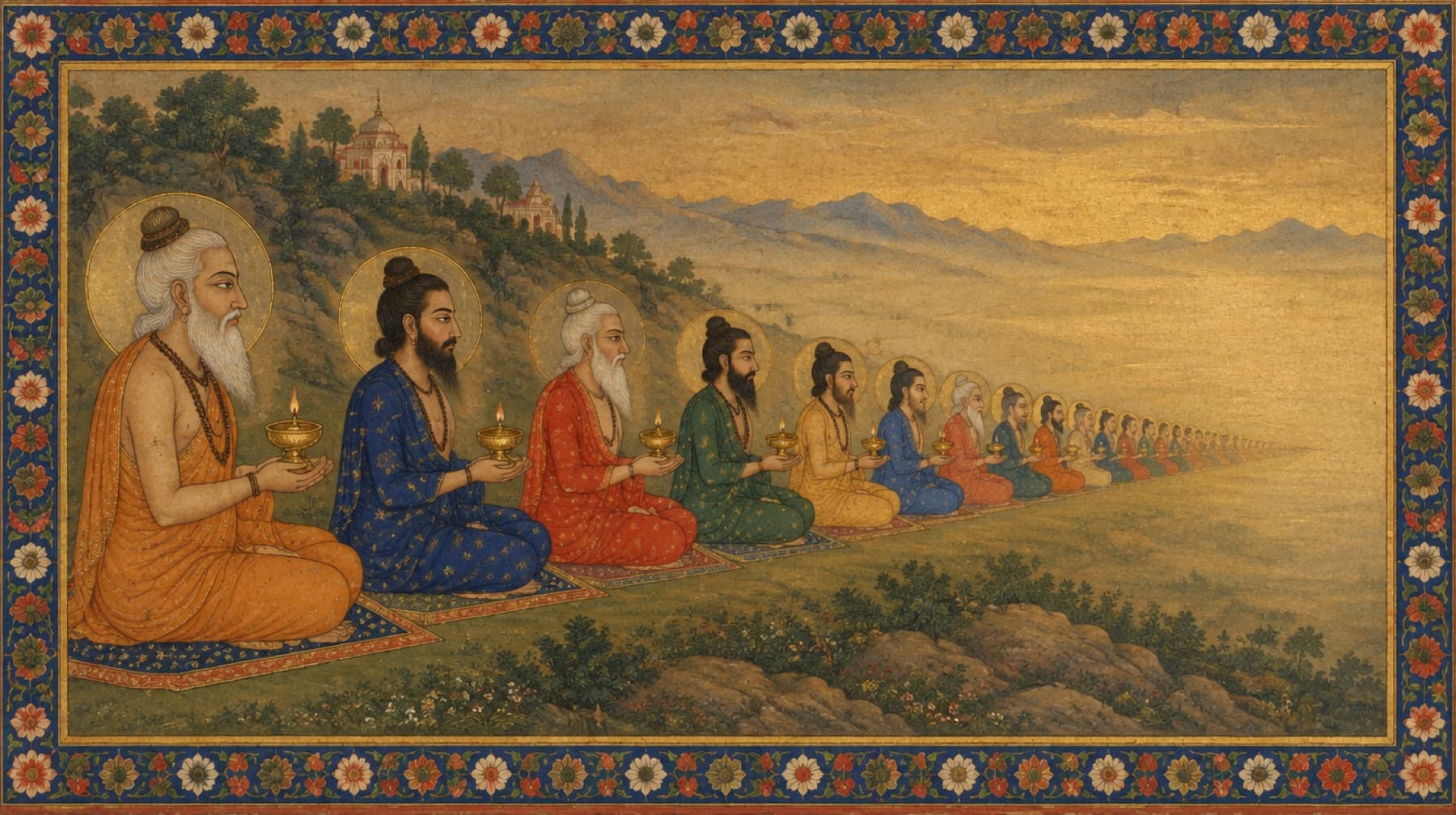
Chapter 4 of 18
Knowledge, Action, and Letting Go
ज्ञानकर्मसंन्यासयोगः
Jñāna-karma-sannyāsa Yoga · 42 verses
Krishna says this teaching is old, and that he has taught it before. Arjuna asks how that can be, since they are both alive now. The answer opens out into who Krishna is, and why the divine takes form when things go badly wrong.
Where this chapter leaves you
The teacher stops being only a friend and charioteer. The teaching gains a lineage, and action gains a deeper reason than duty.
The verses
42 / 42 explainedChapter 4 · Verse 1
इमं विवस्वते योगं प्रोक्तवानहमव्ययम्।विवस्वान् मनवे प्राह मनुरिक्ष्वाकवेऽब्रवीत्॥
Krishna said: I taught this unfading practice to the sun. The sun told Manu. Manu told Ikshvaku.
A new chapter, and it opens by handing you a chain of names.
Read the explanationChapter 4 · Verse 2
एवं परम्पराप्राप्तमिमं राजर्षयो विदुः।स कालेनेह महता योगो नष्टः परन्तप॥
Passed down like that, the kings who were also seers knew it. Over a long stretch of time, Arjuna, the practice was lost here.
And then it was lost.
Read the explanationChapter 4 · Verse 3
स एवायं मया तेऽद्य योगः प्रोक्तः पुरातनः।भक्तोऽसि मे सखा चेति रहस्यं ह्येतदुत्तमम्॥
That same ancient practice is what I have told you today. You are devoted to me, and you are my friend. That is why - this is the best of secrets.
Krishna gives the reason Arjuna is hearing this, and it is not the reason you would expect.
Read the explanationChapter 4 · Verse 4
अपरं भवतो जन्म परं जन्म विवस्वतः।कथमेतद्विजानीयां त्वमादौ प्रोक्तवानिति॥
Arjuna said: You were born later. The sun was born long before. How am I supposed to understand that you taught him at the beginning?
Arjuna asks the obvious question, and he is right to.
Read the explanationChapter 4 · Verse 5
बहूनि मे व्यतीतानि जन्मानि तव चार्जुन।तान्यहं वेद सर्वाणि न त्वं वेत्थ परन्तप॥
Krishna said: Many births have gone past for me, Arjuna, and for you. I know all of them. You do not.
The answer starts with a symmetry and ends with a difference.
Read the explanationChapter 4 · Verse 6
अजोऽपि सन्नव्ययात्मा भूतानामीश्वरोऽपि सन्।प्रकृतिं स्वामधिष्ठाय संभवाम्यात्ममायया॥
Though I am unborn and do not decay, though I am the lord of what exists - I take up my own nature and come into being by my own power.
Three concessions and then a contradiction, held in one line.
Read the explanationChapter 4 · Verse 7
यदा यदा हि धर्मस्य ग्लानिर्भवति भारत।अभ्युत्थानमधर्मस्य तदाऽऽत्मानं सृजाम्यहम्॥
Whenever what is right grows weak, Bharata, and what is wrong rises up, then I send myself forth.
This is a promise, and it is the most quoted promise in the book.
Read the explanationChapter 4 · Verse 8
परित्राणाय साधूनां विनाशाय च दुष्कृताम्।धर्मसंस्थापनार्थाय संभवामि युगे युगे॥
To protect those who are good, to undo those doing harm, to set right what is right - I come into being, age after age.
The promise of 4.7 given its purpose.
Read the explanationChapter 4 · Verse 9
जन्म कर्म च मे दिव्यमेवं यो वेत्ति तत्त्वतः।त्यक्त्वा देहं पुनर्जन्म नैति मामेति सोऽर्जुन॥
Whoever truly knows how my coming and my acting are divine does not take another birth when he leaves the body. He comes to me, Arjuna.
A promise attached to knowing one specific thing.
Read the explanationChapter 4 · Verse 10
वीतरागभयक्रोधा मन्मया मामुपाश्रिताः।बहवो ज्ञानतपसा पूता मद्भावमागताः॥
Freed of wanting, fear and anger, filled with me, taking shelter in me, made clean in the fire of knowing - many have come into the way I am.
And here is the evidence: many have done this.
Read the explanationChapter 4 · Verse 11
ये यथा मां प्रपद्यन्ते तांस्तथैव भजाम्यहम्।मम वर्त्मानुवर्तन्ते मनुष्याः पार्थ सर्वशः॥
However people come to me, that is how I meet them. Everyone follows my path, Arjuna, in every way.
One of the most generous lines in the book, and it works by reflection.
Read the explanationChapter 4 · Verse 12
काङ्क्षन्तः कर्मणां सिद्धिं यजन्त इह देवताः।क्षिप्रं हि मानुषे लोके सिद्धिर्भवति कर्मजा॥
People who want their actions to succeed make offerings to the powers here. Results come quickly in the human world, from what is done.
A flat observation with no criticism attached, which is itself surprising.
Read the explanationChapter 4 · Verse 13
चातुर्वर्ण्यं मया सृष्टं गुणकर्मविभागशः।तस्य कर्तारमपि मां विद्ध्यकर्तारमव्ययम्॥
The four orders were brought out by me, divided by quality and by work. Know that I made them - and also that I do nothing and do not change.
The verse about the four social orders, and it has been fought over for centuries.
Read the explanationChapter 4 · Verse 14
न मां कर्माणि लिम्पन्ति न मे कर्मफले स्पृहा।इति मां योऽभिजानाति कर्मभिर्न स बध्यते॥
Actions do not smear me, and I have no appetite for what they produce. Whoever knows me like that is not tied down by anything he does.
Krishna explains how he can act and not be a doer.
Read the explanationChapter 4 · Verse 15
एवं ज्ञात्वा कृतं कर्म पूर्वैरपि मुमुक्षुभिः।कुरु कर्मैव तस्मात्त्वं पूर्वैः पूर्वतरं कृतम्॥
Knowing this, people long ago who wanted to be free still did the work. So do the work - the way it was done before you, long before.
The conclusion, and it is an instruction to copy.
Read the explanationChapter 4 · Verse 16
किं कर्म किमकर्मेति कवयोऽप्यत्र मोहिताः।तत्ते कर्म प्रवक्ष्यामि यज्ज्ञात्वा मोक्ष्यसेऽशुभात्॥
Even the wise are confused about what counts as acting and what counts as not acting. I will tell you what action is, and knowing it will free you from harm.
Krishna admits the question is hard.
Read the explanationChapter 4 · Verse 17
कर्मणो ह्यपि बोद्धव्यं बोद्धव्यं च विकर्मणः।अकर्मणश्च बोद्धव्यं गहना कर्मणो गतिः॥
You have to understand action, and you have to understand wrong action, and you have to understand not acting. The way action works runs deep.
Three things to understand, and then a warning.
Read the explanationChapter 4 · Verse 18
कर्मण्यकर्म यः पश्येदकर्मणि च कर्म यः।स बुद्धिमान् मनुष्येषु स युक्तः कृत्स्नकर्मकृत्॥
Whoever sees not-acting in action, and acting in not-acting, is the one with understanding among people. He is joined, and he has done everything that needed doing.
The famous line, and it reads like a puzzle until you have the key.
Read the explanationChapter 4 · Verse 19
यस्य सर्वे समारम्भाः कामसङ्कल्पवर्जिताः।ज्ञानाग्निदग्धकर्माणं तमाहुः पण्डितं बुधाः॥
Whoever starts everything he starts without wanting and without scheming for it - his actions burnt up in the fire of knowing - the wise call that one a scholar.
A portrait in one line, and a striking image at the centre.
Read the explanationChapter 4 · Verse 20
त्यक्त्वा कर्मफलासङ्गं नित्यतृप्तो निराश्रयः।कर्मण्यभिप्रवृत्तोऽपि नैव किञ्चित्करोति सः॥
Having let go of holding on to what his actions bring, always content, depending on nothing - he does nothing at all, even while fully at work.
The paradox of verse 18, now stated plainly.
Read the explanationChapter 4 · Verse 21
निराशीर्यतचित्तात्मा त्यक्तसर्वपरिग्रहः।शारीरं केवलं कर्म कुर्वन्नाप्नोति किल्बिषम्॥
Expecting nothing, mind and self in hand, having given up every kind of owning - doing only what the body does, he takes on no fault.
The same portrait from a different angle, and one phrase stands out.
Read the explanationChapter 4 · Verse 22
यदृच्छालाभसन्तुष्टो द्वन्द्वातीतो विमत्सरः।समः सिद्धावसिद्धौ च कृत्वापि न निबध्यते॥
Content with whatever comes, past the pairs, free of grudging, the same in success and failure - even acting, he is not bound.
Four marks, and the first is the most practical.
Read the explanationChapter 4 · Verse 23
गतसङ्गस्य मुक्तस्य ज्ञानावस्थितचेतसः।यज्ञायाचरतः कर्म समग्रं प्रविलीयते॥
For someone unattached and free, his mind settled in knowing, acting as an offering - everything he does dissolves completely.
The summary of the whole argument so far.
Read the explanationChapter 4 · Verse 24
ब्रह्मार्पणं ब्रह्महविर्ब्रह्माग्नौ ब्रह्मणा हुतम्।ब्रह्मैव तेन गन्तव्यं ब्रह्मकर्मसमाधिना॥
The offering is the infinite. What is offered is the infinite. It is poured by the infinite into the fire of the infinite. Whoever is absorbed in that reaches the infinite.
One word, five times.
Read the explanationChapter 4 · Verse 25
दैवमेवापरे यज्ञं योगिनः पर्युपासते।ब्रह्माग्नावपरे यज्ञं यज्ञेनैवोपजुह्वति॥
Some who practise make their offering to the powers above. Others pour the offering itself into the fire of the infinite.
The catalogue begins.
Read the explanationChapter 4 · Verse 26
श्रोत्रादीनीन्द्रियाण्यन्ये संयमाग्निषु जुह्वति।शब्दादीन्विषयानन्य इन्द्रियाग्निषु जुह्वति॥
Some pour hearing and the other senses into the fire of restraint. Others pour sound and the other objects into the fire of the senses.
Two opposite practices, described in the same terms.
Read the explanationChapter 4 · Verse 27
सर्वाणीन्द्रियकर्माणि प्राणकर्माणि चापरे।आत्मसंयमयोगाग्नौ जुह्वति ज्ञानदीपिते॥
Others pour all the workings of the senses and of the breath into the fire of holding oneself together, kindled by knowing.
A third practice, and it is more total than the first two.
Read the explanationChapter 4 · Verse 28
द्रव्ययज्ञास्तपोयज्ञा योगयज्ञास्तथापरे।स्वाध्यायज्ञानयज्ञाश्च यतयः संशितव्रताः॥
Some offer what they own. Some offer hard practice. Some offer the disciplines. Some offer study and knowing - people who have taken firm vows and hold to them.
Four more, and they are recognisably ordinary.
Read the explanationChapter 4 · Verse 29
अपाने जुह्वति प्राणं प्राणेऽपानं तथापरे ।प्राणापानगती रुद्ध्वा प्राणायामपरायणाः॥
Others pour the out-breath into the in-breath and the in-breath into the out-breath, stopping the movement of both, given wholly to the control of breath.
The most technical verse in the catalogue, and it is about breathing.
Read the explanationChapter 4 · Verse 30
अपरे नियताहाराः प्राणान्प्राणेषु जुह्वति।सर्वेऽप्येते यज्ञविदो यज्ञक्षपितकल्मषाः॥
Others hold back what they eat and pour the breaths into the breath. All of these understand offering, and what is unclean in them is worn away by it.
The catalogue closes, and the closing line is the point.
Read the explanationChapter 4 · Verse 31
यज्ञशिष्टामृतभुजो यान्ति ब्रह्म सनातनम् ।नायं लोकोऽस्त्ययज्ञस्य कुतोऽन्यः कुरुसत्तम॥
Those who eat what is left after the offering go to what lasts. For the one who offers nothing, this world does not work - let alone any other.
The closing argument of the catalogue, and it is blunt.
Read the explanationChapter 4 · Verse 32
एवं बहुविधा यज्ञा वितता ब्रह्मणो मुखे।कर्मजान्विद्धि तान्सर्वानेवं ज्ञात्वा विमोक्ष्यसे॥
Many kinds of offering are spread out before what is highest. Know that all of them are born from action. Knowing that, you will be free.
The catalogue is closed off with a single observation.
Read the explanationChapter 4 · Verse 33
श्रेयान्द्रव्यमयाद्यज्ञाज्ज्ञानयज्ञः परन्तप।सर्वं कर्माखिलं पार्थ ज्ञाने परिसमाप्यते॥
Better than any offering made of things is the offering of knowing, Arjuna. All action, without exception, comes to its end in knowing.
The one ranking in the chapter, and it arrives after everything has been levelled.
Read the explanationChapter 4 · Verse 34
तद्विद्धि प्रणिपातेन परिप्रश्नेन सेवया।उपदेक्ष्यन्ति ते ज्ञानं ज्ञानिनस्तत्त्वदर्शिनः॥
Learn it by going and bowing, by asking properly, by being of use. Those who know, who have seen how things are, will teach it to you.
The most practical instruction in the Gita, and it has three parts.
Read the explanationChapter 4 · Verse 35
यज्ज्ञात्वा न पुनर्मोहमेवं यास्यसि पाण्डव।येन भूतान्यशेषेण द्रक्ष्यस्यात्मन्यथो मयि॥
Knowing that, Arjuna, you will not fall into this confusion again. By it you will see every being, without exception, in yourself - and then in me.
The result of learning it, and it is a change in vision.
Read the explanationChapter 4 · Verse 36
अपि चेदसि पापेभ्यः सर्वेभ्यः पापकृत्तमः।सर्वं ज्ञानप्लवेनैव वृजिनं सन्तरिष्यसि॥
Even if you were the worst of all who have done harm, you would cross over everything crooked in the boat of knowing.
One of the most generous sentences in the book.
Read the explanationChapter 4 · Verse 37
यथैधांसि समिद्धोऽग्निर्भस्मसात्कुरुतेऽर्जुन।ज्ञानाग्निः सर्वकर्माणि भस्मसात्कुरुते तथा॥
As a fire well lit turns firewood to ash, Arjuna, the fire of knowing turns every action to ash in the same way.
The mechanism behind verse 36, in one image.
Read the explanationChapter 4 · Verse 38
न हि ज्ञानेन सदृशं पवित्रमिह विद्यते।तत्स्वयं योगसंसिद्धः कालेनात्मनि विन्दति॥
There is nothing in this world as clean as knowing. Whoever has come to completeness in the practice finds it in himself, in time.
A very big claim, and then a very patient promise.
Read the explanationChapter 4 · Verse 39
श्रद्धावाँल्लभते ज्ञानं तत्परः संयतेन्द्रियः।ज्ञानं लब्ध्वा परां शान्तिमचिरेणाधिगच्छति॥
The one who trusts it gets it - devoted to it, with the senses in hand. Having got it, he comes very soon to the deepest peace.
Three conditions, and then a promise that is suddenly fast.
Read the explanationChapter 4 · Verse 40
अज्ञश्चाश्रद्दधानश्च संशयात्मा विनश्यति।नायं लोकोऽस्ति न परो न सुखं संशयात्मनः॥
The one who does not know, who does not trust, whose self is made of doubt - he is lost. For the one made of doubt there is no this world, no other one, and no happiness.
The counter-case, and it is the harshest sentence in the chapter.
Read the explanationChapter 4 · Verse 41
योगसंन्यस्तकर्माणं ज्ञानसंछिन्नसंशयम्।आत्मवन्तं न कर्माणि निबध्नन्ति धनञ्जय॥
Actions do not bind the one who has given his actions over through the practice, whose doubts knowing has cut away, who is in possession of himself.
The summary of the whole chapter in one line.
Read the explanationChapter 4 · Verse 42
तस्मादज्ञानसंभूतं हृत्स्थं ज्ञानासिनाऽऽत्मनः।छित्त्वैनं संशयं योगमातिष्ठोत्तिष्ठ भारत॥
So cut this doubt of yours - the one sitting in your heart, born of not knowing - with the sword of knowing. Take up the practice, Arjuna. Stand up.
The chapter ends where Chapter 2 began: uttiṣṭha - stand up.
Read the explanation