Chapter 5 of 18
Giving Up, and Getting On With It
कर्मसंन्यासयोगः
Karma-sannyāsa Yoga · 29 verses
Arjuna is still confused. Krishna keeps praising both giving things up and getting on with the work. Which is it? Krishna answers that they arrive at the same place, but one is easier to walk. You can hold everything lightly while your hands are still busy.
Where this chapter leaves you
The false choice between the monastery and the world is dissolved. Renunciation moves from the outside of a life to the inside of it.
The verses
29 / 29 explainedChapter 5 · Verse 1
संन्यासं कर्मणां कृष्ण पुनर्योगं च शंससि ।यच्छ्रेय एतयोरेकं तन्मे ब्रूहि सुनिश्चितम्॥
Arjuna said: You praise setting action down, Krishna, and then you praise the practice of action. Tell me plainly which one of these is better.
Arjuna asks the same question for the third time.
Read the explanationChapter 5 · Verse 2
संन्यासः कर्मयोगश्च निःश्रेयसकरावुभौ।तयोस्तु कर्मसंन्यासात्कर्मयोगो विशिष्यते॥
Krishna said: Both setting action down and the practice of action lead to the highest good. But of the two, the practice of action is better than setting action down.
A straight answer, which is rare.
Read the explanationChapter 5 · Verse 3
ज्ञेयः स नित्यसंन्यासी यो न द्वेष्टि न काङ्क्षति।निर्द्वन्द्वो हि महाबाहो सुखं बन्धात्प्रमुच्यते॥
Know him as a permanent renouncer who neither hates nor craves. Free of the pairs, Arjuna, he is easily released from what binds him.
Renunciation gets redefined here, and the new definition has nothing to do with what you own.
Read the explanationChapter 5 · Verse 4
सांख्ययोगौ पृथग्बालाः प्रवदन्ति न पण्डिताः।एकमप्यास्थितः सम्यगुभयोर्विन्दते फलम्॥
Children say that analysis and practice are separate things. The wise do not. Standing properly in even one of them, a person gets the fruit of both.
Blunter than it looks.
Read the explanationChapter 5 · Verse 5
यत्सांख्यैः प्राप्यते स्थानं तद्योगैरपि गम्यते।एकं सांख्यं च योगं च यः पश्यति स पश्यति॥
The place reached by analysis is reached by practice too. Whoever sees analysis and practice as one, sees.
The same point again, and the last line is the interesting part.
Read the explanationChapter 5 · Verse 6
संन्यासस्तु महाबाहो दुःखमाप्तुमयोगतः।योगयुक्तो मुनिर्ब्रह्म नचिरेणाधिगच्छति॥
But setting action down is hard to reach without practice, Arjuna. The sage joined to practice reaches the infinite before long.
Here is the reason for the ranking at 5.2.
Read the explanationChapter 5 · Verse 7
योगयुक्तो विशुद्धात्मा विजितात्मा जितेन्द्रियः।सर्वभूतात्मभूतात्मा कुर्वन्नपि न लिप्यते॥
Joined to practice, clear in himself, his self mastered, his senses mastered - his own self having become the self of all beings - even acting, he is not smeared.
The portrait, in one long compound.
Read the explanationChapter 5 · Verse 8
नैव किञ्चित्करोमीति युक्तो मन्येत तत्त्ववित्।पश्यञ्शृण्वन्स्पृशञ्जिघ्रन्नश्नन्गच्छन्स्वपञ्श्वसन्॥
The one who is joined, who knows how things are, thinks: I do nothing at all - while seeing, hearing, touching, smelling, eating, moving, sleeping, breathing.
A list of eight completely ordinary actions.
Read the explanationChapter 5 · Verse 9
प्रलपन्विसृजन्गृह्णन्नुन्मिषन्निमिषन्नपि।इन्द्रियाणीन्द्रियार्थेषु वर्तन्त इति धारयन्॥
Speaking, letting go, taking hold, opening the eyes and closing them - holding throughout that the senses are simply moving among the things of the senses.
The list continues and gets smaller.
Read the explanationChapter 5 · Verse 10
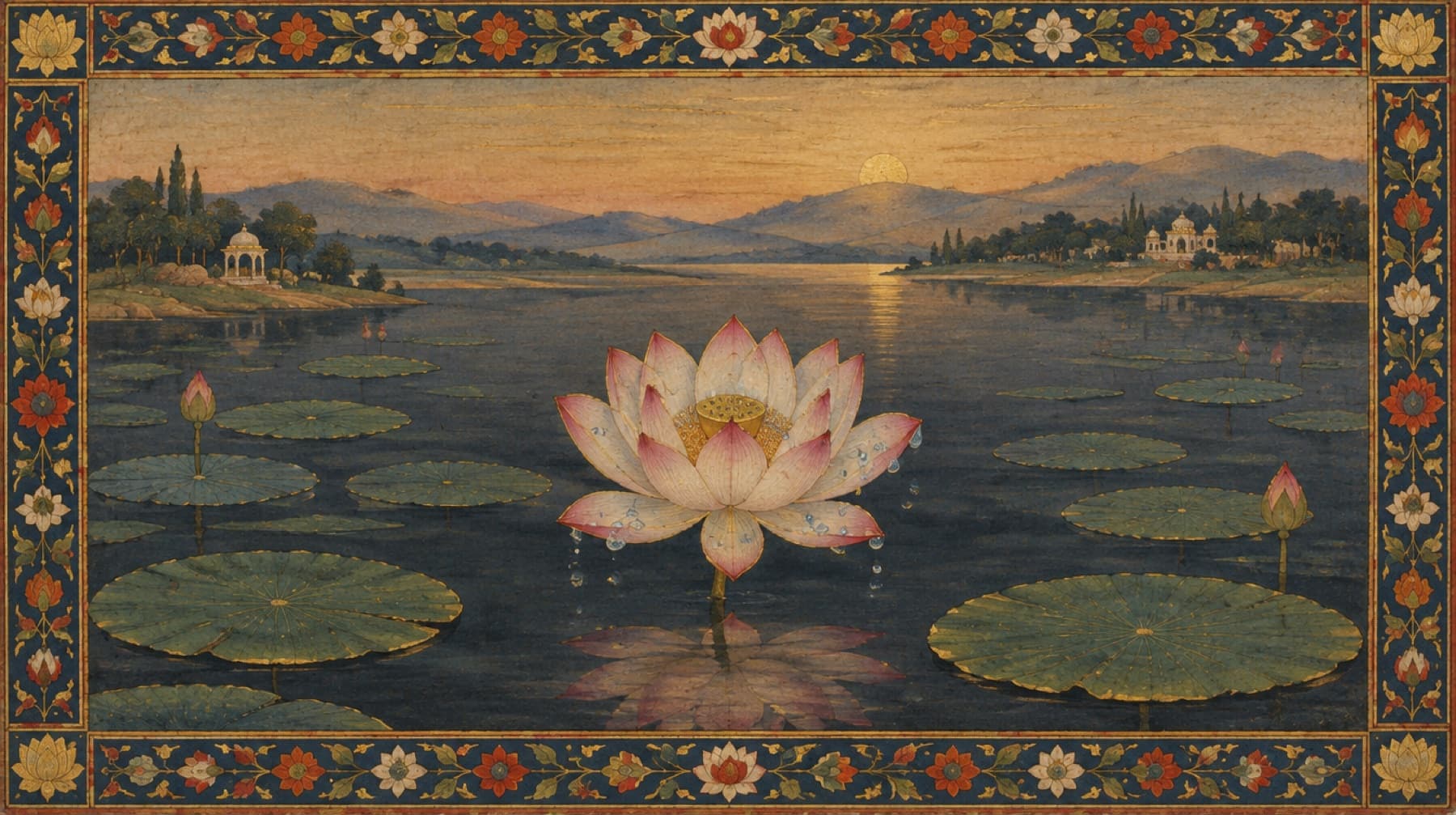
ब्रह्मण्याधाय कर्माणि सङ्गं त्यक्त्वा करोति यः।लिप्यते न स पापेन पद्मपत्रमिवाम्भसा॥
Whoever acts placing his actions in the infinite, having given up attachment, is not stained by wrong - as a lotus leaf is not wetted by water.
The image everybody remembers from this chapter.
Read the explanationChapter 5 · Verse 11
कायेन मनसा बुद्ध्या केवलैरिन्द्रियैरपि।योगिनः कर्म कुर्वन्ति सङ्गं त्यक्त्वाऽऽत्मशुद्धये॥
With the body, with the mind, with the understanding, and even with the bare senses, those in practice act, giving up attachment, for their own clearing.
Four instruments, listed plainly: body, mind, understanding, senses.
Read the explanationChapter 5 · Verse 12
युक्तः कर्मफलं त्यक्त्वा शान्तिमाप्नोति नैष्ठिकीम्।अयुक्तः कामकारेण फले सक्तो निबध्यते॥
The one who is joined, giving up what his action will fetch, reaches a settled peace. The one who is not, pulled by wanting, attached to the fruit, is bound.
Two people, same action, opposite results.
Read the explanationChapter 5 · Verse 13
सर्वकर्माणि मनसा संन्यस्यास्ते सुखं वशी।नवद्वारे पुरे देही नैव कुर्वन्न कारयन्॥
Having set all actions down with the mind, the embodied one rests happily in the city of nine gates, neither acting nor causing action.
A body described as a walled town with nine ways in and out.
Read the explanationChapter 5 · Verse 14
न कर्तृत्वं न कर्माणि लोकस्य सृजति प्रभुः।न कर्मफलसंयोगं स्वभावस्तु प्रवर्तते॥
The lord does not create the world's doership, or its actions, or the joining of action to its fruit. Its own nature carries on.
A denial in three parts, and it is unusually specific.
Read the explanationChapter 5 · Verse 15
नादत्ते कस्यचित्पापं न चैव सुकृतं विभुः।अज्ञानेनावृतं ज्ञानं तेन मुह्यन्ति जन्तवः॥
The all-pervading takes on no one's wrongdoing, and no one's good deed either. Knowing is covered over by not-knowing, and that is why creatures are confused.
Nobody's account is being kept by the one in charge.
Read the explanationChapter 5 · Verse 16
ज्ञानेन तु तदज्ञानं येषां नाशितमात्मनः।तेषामादित्यवज्ज्ञानं प्रकाशयति तत्परम्॥
But for those whose not-knowing has been destroyed by knowing the self, their knowing lights up that highest thing, the way the sun does.
The answer to the covering described in the last verse.
Read the explanationChapter 5 · Verse 17
तद्बुद्धयस्तदात्मानस्तन्निष्ठास्तत्परायणाः।गच्छन्त्यपुनरावृत्तिं ज्ञाननिर्धूतकल्मषाः॥
With their understanding in it, their very selves in it, standing in it, given over to it - they go to the state of no return, their stains shaken off by knowing.
Four phrases, and all four say the same thing.
Read the explanationChapter 5 · Verse 18
विद्याविनयसंपन्ने ब्राह्मणे गवि हस्तिनि।शुनि चैव श्वपाके च पण्डिताः समदर्शिनः॥
In a brahmin full of learning and humility, in a cow, in an elephant, in a dog, and in one who cooks dogs - the wise see the same.
A list designed to be uncomfortable.
Read the explanationChapter 5 · Verse 19
इहैव तैर्जितः सर्गो येषां साम्ये स्थितं मनः।निर्दोषं हि समं ब्रह्म तस्माद्ब्रह्मणि ते स्थिताः॥
Even here, coming and going has been conquered by those whose minds stand in evenness. The infinite is flawless and even, and so they stand in the infinite.
Ihaiva - right here, in this life.
Read the explanationChapter 5 · Verse 20
न प्रहृष्येत्प्रियं प्राप्य नोद्विजेत्प्राप्य चाप्रियम्।स्थिरबुद्धिरसम्मूढो ब्रह्मविद्ब्रह्मणि स्थितः॥
He does not leap up when something pleasant comes, and does not recoil when something unpleasant does. Steady in understanding, unconfused, knowing the infinite, he stands in it.
Two verbs, and both are physical.
Read the explanationChapter 5 · Verse 21
बाह्यस्पर्शेष्वसक्तात्मा विन्दत्यात्मनि यत्सुखम्।स ब्रह्मयोगयुक्तात्मा सुखमक्षयमश्नुते॥
With his self unattached to outside contacts, he finds the happiness that is in the self. His self joined to the infinite, he reaches a happiness that does not run out.
Two kinds of happiness, told apart by where they come from.
Read the explanationChapter 5 · Verse 22
ये हि संस्पर्शजा भोगा दुःखयोनय एव ते।आद्यन्तवन्तः कौन्तेय न तेषु रमते बुधः॥
The enjoyments born of contact are wombs of suffering. They have a beginning and an end, Arjuna. The wise do not take their delight in them.
A hard sentence, and the hardest word is in the middle.
Read the explanationChapter 5 · Verse 23
शक्नोतीहैव यः सोढुं प्राक्शरीरविमोक्षणात्।कामक्रोधोद्भवं वेगं स युक्तः स सुखी नरः॥
Whoever can bear, here and now, before letting go of the body, the force that rises from wanting and anger - he is joined, and he is a happy man.
The most practical verse in the chapter.
Read the explanationChapter 5 · Verse 24
योऽन्तःसुखोऽन्तरारामस्तथान्तर्ज्योतिरेव यः।स योगी ब्रह्मनिर्वाणं ब्रह्मभूतोऽधिगच्छति॥
Whoever finds his happiness within, his rest within, his light within - that practitioner, having become the infinite, reaches the peace of the infinite.
Three things, all relocated to the same place.
Read the explanationChapter 5 · Verse 25
लभन्ते ब्रह्मनिर्वाणमृषयः क्षीणकल्मषाः।छिन्नद्वैधा यतात्मानः सर्वभूतहिते रताः॥
Those seers whose stains are worn thin reach the peace of the infinite - their doubleness cut away, themselves restrained, taking delight in the good of all beings.
The list ends somewhere unexpected.
Read the explanationChapter 5 · Verse 26
कामक्रोधवियुक्तानां यतीनां यतचेतसाम्।अभितो ब्रह्मनिर्वाणं वर्तते विदितात्मनाम्॥
For those freed from wanting and anger, restrained in themselves, restrained in mind, who have come to know the self - the peace of the infinite is near on every side.
Abhitaḥ - on both sides, all around, near at hand.
Read the explanationChapter 5 · Verse 27
स्पर्शान्कृत्वा बहिर्बाह्यांश्चक्षुश्चैवान्तरे भ्रुवोः।प्राणापानौ समौ कृत्वा नासाभ्यन्तरचारिणौ॥
Putting outside contacts outside, the gaze held between the brows, making the in-breath and the out-breath even as they move in the nostrils…
A physical instruction, and the chapter has not given one before.
Read the explanationChapter 5 · Verse 28
यतेन्द्रियमनोबुद्धिर्मुनिर्मोक्षपरायणः।विगतेच्छाभयक्रोधो यः सदा मुक्त एव सः॥
… the sage with senses, mind and understanding held steady, aiming at release, with wanting, fear and anger gone: he is free already, always.
The sentence that began in the last verse lands here.
Read the explanationChapter 5 · Verse 29
भोक्तारं यज्ञतपसां सर्वलोकमहेश्वरम्।सुहृदं सर्वभूतानां ज्ञात्वा मां शान्तिमृच्छति॥
Knowing me as the one who receives all offerings and practices, the great lord of all worlds, the friend of every being - he comes to peace.
Three descriptions, and the third is the surprise.
Read the explanation