Chapter 15 of 18
The Highest Person
पुरुषोत्तमयोगः
Puruṣottama Yoga · 20 verses
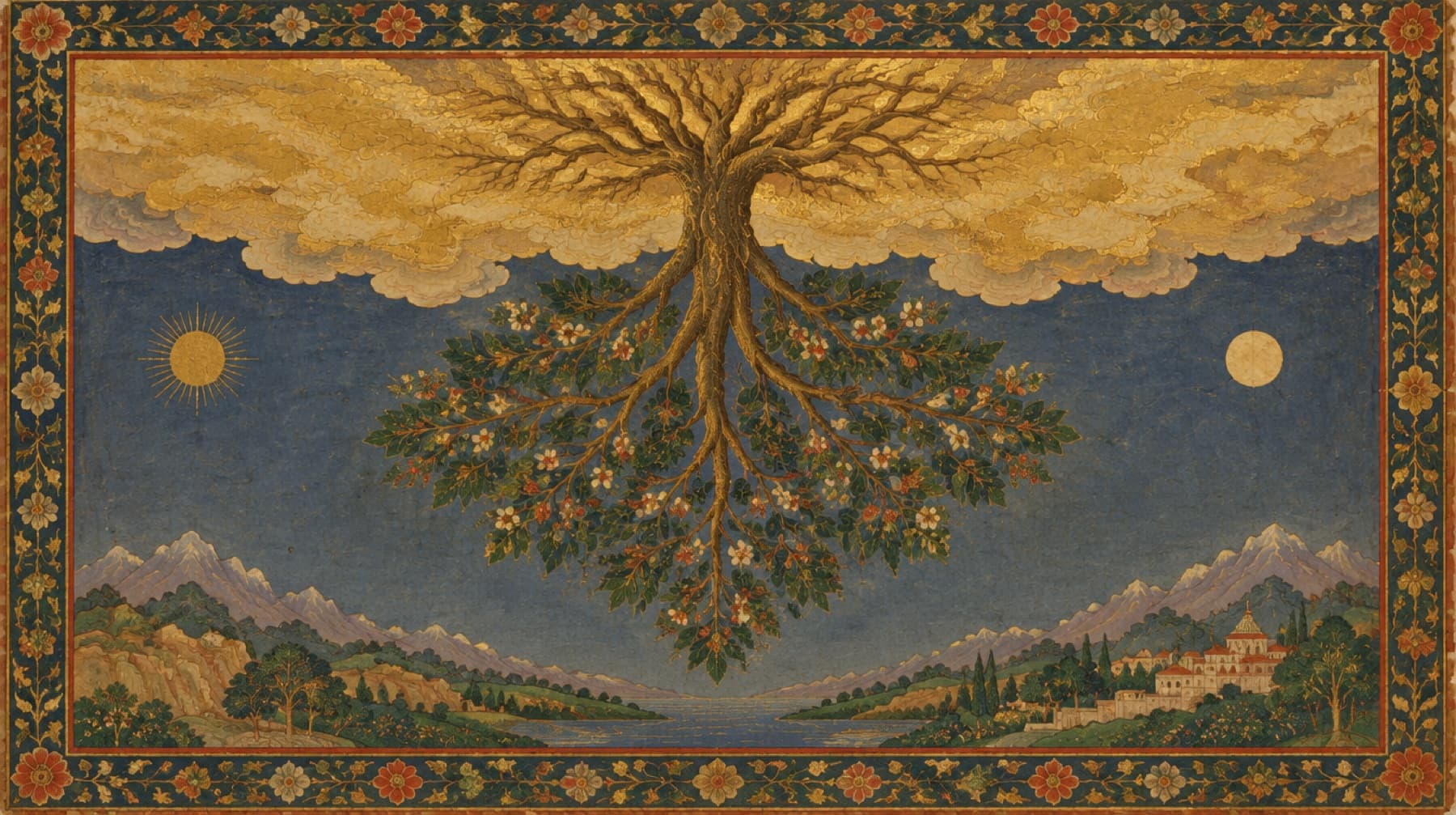
An upside-down tree, roots in the sky and branches below, as an image of the world we live in. Krishna says to take an axe to it - not to the world, but to the attachment that keeps you hanging in its branches.
Where this chapter leaves you
The shortest complete statement of the Gita's metaphysics, ending with what stands above both the perishable and the imperishable.
The verses
20 / 20 explainedChapter 15 · Verse 1
ऊर्ध्वमूलमधःशाखमश्वत्थं प्राहुरव्ययम्।छन्दांसि यस्य पर्णानि यस्तं वेद स वेदवित्॥
They speak of an unfading fig tree with its roots above and its branches below, and the hymns are its leaves. Whoever knows that tree knows the Veda.
Krishna starts with a picture, and he turns it upside down on purpose.
Read the explanationChapter 15 · Verse 2
अधश्चोर्ध्वं प्रसृतास्तस्य शाखा गुणप्रवृद्धा विषयप्रवालाः।अधश्च मूलान्यनुसन्ततानि कर्मानुबन्धीनि मनुष्यलोके॥
Its branches spread below and above, fed by the three strands of nature, with the things of the senses for buds. And downward run roots as well, binding to action in the world of people.
He fills the tree in.
Read the explanationChapter 15 · Verse 3
न रूपमस्येह तथोपलभ्यते नान्तो न चादिर्न च संप्रतिष्ठा।अश्वत्थमेनं सुविरूढमूल मसङ्गशस्त्रेण दृढेन छित्त्वा॥
Its form is not to be found here - no end, no beginning, no ground it stands on. Cut this deep-rooted fig tree down with the firm axe of not-clinging.
You cannot see the shape of the tree, because you are standing inside it.
Read the explanationChapter 15 · Verse 4
ततः पदं तत्परिमार्गितव्यं यस्मिन्गता न निवर्तन्ति भूयः ।तमेव चाद्यं पुरुषं प्रपद्ये ।यतः प्रवृत्तिः प्रसृता पुराणी॥
Then that place must be searched out, the place where those who go do not come back. And I take refuge in that first Person, the one this ancient flowing-out came from.
Cutting is only half of it.
Read the explanationChapter 15 · Verse 5
निर्मानमोहा जितसङ्गदोषा अध्यात्मनित्या विनिवृत्तकामाः।द्वन्द्वैर्विमुक्ताः सुखदुःखसंज्ञै र्गच्छन्त्यमूढाः पदमव्ययं तत्॥
Free of pride and confusion, with the fault of clinging beaten, settled in the self, their wanting gone quiet, released from the pairs we call pleasure and pain - the unfooled reach that place that does not fade.
A list of who gets there, and it is worth reading slowly.
Read the explanationChapter 15 · Verse 6
न तद्भासयते सूर्यो न शशाङ्को न पावकः।यद्गत्वा न निवर्तन्ते तद्धाम परमं मम॥
No sun lights that place, no moon, no fire. Those who go there do not come back. That is my highest home.
Three lights, all turned down.
Read the explanationChapter 15 · Verse 7
ममैवांशो जीवलोके जीवभूतः सनातनः।मनःषष्ठानीन्द्रियाणि प्रकृतिस्थानि कर्षति॥
A fragment of my own self, lasting for ever, becomes the living being in the world of the living. It draws to itself the six senses, the mind among them, which rest in nature.
This is one of the largest sentences in the book.
Read the explanationChapter 15 · Verse 8
शरीरं यदवाप्नोति यच्चाप्युत्क्रामतीश्वरः।गृहीत्वैतानि संयाति वायुर्गन्धानिवाशयात्॥
When the lord of the body takes a body up, and when he leaves one behind, he carries these with him, as the wind carries scents from where they sit.
The senses and the mind are not left behind.
Read the explanationChapter 15 · Verse 9
श्रोत्रं चक्षुः स्पर्शनं च रसनं घ्राणमेव च।अधिष्ठाय मनश्चायं विषयानुपसेवते॥
Settled in hearing, in sight, in touch, in taste and in smell, and in the mind as well, he takes in the things of the world.
The list is deliberately plain.
Read the explanationChapter 15 · Verse 10
उत्क्रामन्तं स्थितं वापि भुञ्जानं वा गुणान्वितम्।विमूढा नानुपश्यन्ति पश्यन्ति ज्ञानचक्षुषः॥
The deluded do not see him as he leaves, or as he stays, or as he takes his pleasure under the strands of nature. Those who have the eye of knowing do see.
Three moments are named - going, staying, enjoying.
Read the explanationChapter 15 · Verse 11
यतन्तो योगिनश्चैनं पश्यन्त्यात्मन्यवस्थितम्।यतन्तोऽप्यकृतात्मानो नैनं पश्यन्त्यचेतसः॥
Those who practise, and who keep at it, see him seated in themselves. Those who have not done the inner work do not see him, however hard they try.
This one is honest in a way that stings a little.
Read the explanationChapter 15 · Verse 12
यदादित्यगतं तेजो जगद्भासयतेऽखिलम्।यच्चन्द्रमसि यच्चाग्नौ तत्तेजो विद्धि मामकम्॥
The brightness in the sun that lights up the whole world, and what is in the moon and in fire - know that brightness as mine.
Having said the sun does not light that place, he now says the sun's light is his.
Read the explanationChapter 15 · Verse 13
गामाविश्य च भूतानि धारयाम्यहमोजसा।पुष्णामि चौषधीः सर्वाः सोमो भूत्वा रसात्मकः॥
Entering the earth, I hold all beings up by my strength. And becoming the moon, full of sap, I feed every plant that grows.
He gets specific, and physical.
Read the explanationChapter 15 · Verse 14
अहं वैश्वानरो भूत्वा प्राणिनां देहमाश्रितः।प्राणापानसमायुक्तः पचाम्यन्नं चतुर्विधम्॥
Becoming the fire that digests, I live in the bodies of everything that breathes. Joined with the breath going out and the breath coming in, I cook the four kinds of food.
This may be the least grand sentence anyone has ever spoken about God.
Read the explanationChapter 15 · Verse 15
सर्वस्य चाहं हृदि सन्निविष्टो मत्तः स्मृतिर्ज्ञानमपोहनं च।वेदैश्च सर्वैरहमेव वेद्यो वेदान्तकृद्वेदविदेव चाहम्॥
I am seated in the heart of everyone. From me come memory, and knowing, and the loss of both. I am what all the Vedas are for. I made the end of the Vedas, and I am the one who knows them.
Four claims in one verse, and the second is the surprising one.
Read the explanationChapter 15 · Verse 16
द्वाविमौ पुरुषौ लोके क्षरश्चाक्षर एव च।क्षरः सर्वाणि भूतानि कूटस्थोऽक्षर उच्यते॥
There are two beings in the world: the one that perishes and the one that does not. All creatures are the perishing one. The one that stands unshaken is called the imperishable.
A piece of plain bookkeeping before the chapter's last move.
Read the explanationChapter 15 · Verse 17
उत्तमः पुरुषस्त्वन्यः परमात्मेत्युदाहृतः।यो लोकत्रयमाविश्य बिभर्त्यव्यय ईश्वरः॥
But the highest being is another: he is called the Supreme Self. He enters the three worlds and holds them up, and he does not wear out - the lord.
Neither column, then.
Read the explanationChapter 15 · Verse 18
यस्मात्क्षरमतीतोऽहमक्षरादपि चोत्तमः।अतोऽस्मि लोके वेदे च प्रथितः पुरुषोत्तमः॥
Because I am beyond what perishes, and higher even than what does not, I am known in the world and in the Veda as the highest Person.
The name is explained rather than announced.
Read the explanationChapter 15 · Verse 19
यो मामेवमसम्मूढो जानाति पुरुषोत्तमम्।स सर्वविद्भजति मां सर्वभावेन भारत॥
Whoever knows me like this, not fooled, as the highest Person - he knows everything, and he loves me with the whole of what he is, Arjuna.
Two things follow from getting this right, and the second is the real one.
Read the explanationChapter 15 · Verse 20
इति गुह्यतमं शास्त्रमिदमुक्तं मयाऽनघ।एतद्बुद्ध्वा बुद्धिमान्स्यात्कृतकृत्यश्च भारत॥
So the most secret teaching has been spoken by me, faultless one. Understanding it, a person becomes wise, and has done what he came to do, Arjuna.
He signs off, and there is a promise folded into the sign-off.
Read the explanation