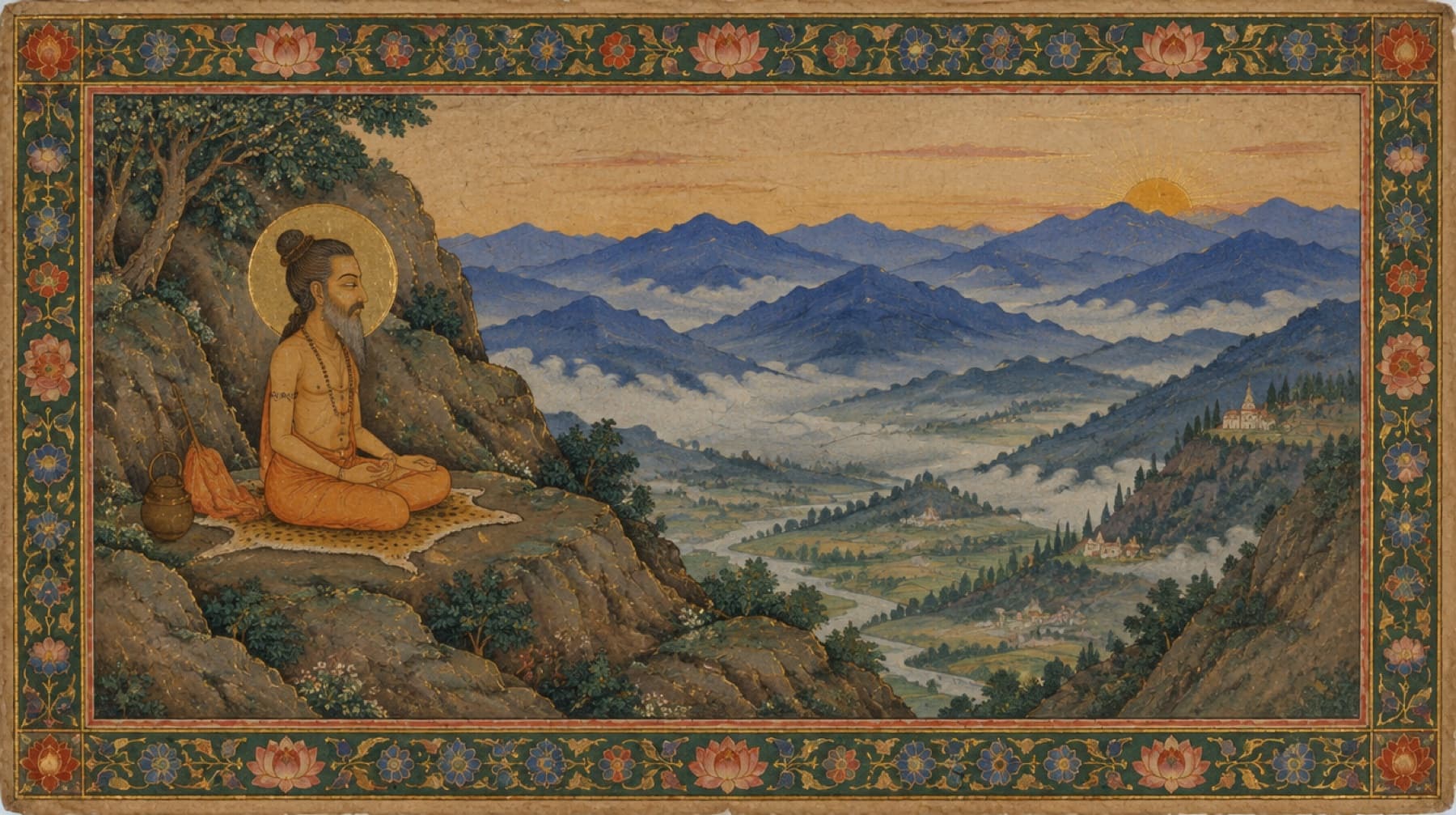
Chapter 6 of 18
Working With Your Own Mind
आत्मसंयमयोगः
Ātma-saṃyama Yoga · 47 verses
The practical chapter. How to sit, how to eat, how to steady attention. Arjuna objects that the mind is as hard to hold as the wind. Krishna agrees - and says it can still be done, by practice and by loosening your grip.
Where this chapter leaves you
The teaching comes down to the level of the body and the breath. It ends by reassuring anyone who tries and falls short: no honest effort here is ever wasted.
The verses
47 / 47 explainedChapter 6 · Verse 1
अनाश्रितः कर्मफलं कार्यं कर्म करोति यः।स संन्यासी च योगी च न निरग्निर्न चाक्रियः॥
Krishna said: Whoever does the work that has to be done without leaning on what it will fetch - he is the renouncer and he is the practitioner. Not the man without ritual fires, and not the man without duties.
The chapter opens by taking a title away from two people.
Read the explanationChapter 6 · Verse 2
यं संन्यासमिति प्राहुर्योगं तं विद्धि पाण्डव।न ह्यसंन्यस्तसङ्कल्पो योगी भवति कश्चन॥
Know that what they call renunciation is the practice itself, Arjuna. For nobody becomes a practitioner without setting down his plans.
The two words are now formally the same word.
Read the explanationChapter 6 · Verse 3
आरुरुक्षोर्मुनेर्योगं कर्म कारणमुच्यते।योगारूढस्य तस्यैव शमः कारणमुच्यते॥
For a sage who wants to climb to the practice, work is called the means. For one who has climbed, stillness is called the means.
Two people, two different instructions, and they are opposites.
Read the explanationChapter 6 · Verse 4
यदा हि नेन्द्रियार्थेषु न कर्मस्वनुषज्जते।सर्वसङ्कल्पसंन्यासी योगारूढस्तदोच्यते॥
When he is not attached to the objects of the senses or to actions, having set down every plan - then he is said to have climbed.
A definition, offered so the last verse can be used.
Read the explanationChapter 6 · Verse 5
उद्धरेदात्मनाऽऽत्मानं नात्मानमवसादयेत्।आत्मैव ह्यात्मनो बन्धुरात्मैव रिपुरात्मनः॥
Lift yourself by yourself. Do not let yourself sink. You alone are your own friend, and you alone are your own enemy.
This is the most practical verse in the Gita, and the least comforting.
Read the explanationChapter 6 · Verse 6
बन्धुरात्माऽऽत्मनस्तस्य येनात्मैवात्मना जितः।अनात्मनस्तु शत्रुत्वे वर्तेतात्मैव शत्रुवत्॥
For the one by whom the self has been conquered by the self, the self is a friend. But for one who has not got hold of himself, his own self stays hostile, like an enemy.
The second half of the sentence that began at 6.5.
Read the explanationChapter 6 · Verse 7
जितात्मनः प्रशान्तस्य परमात्मा समाहितः।शीतोष्णसुखदुःखेषु तथा मानापमानयोः॥
For the one whose self is conquered and who is at peace, the highest self is settled - in cold and heat, in pleasure and pain, in honour and dishonour alike.
Three pairs, and the third is the one that stings.
Read the explanationChapter 6 · Verse 8
ज्ञानविज्ञानतृप्तात्मा कूटस्थो विजितेन्द्रियः।युक्त इत्युच्यते योगी समलोष्टाश्मकाञ्चनः॥
Filled by knowing and by seeing, standing unmoved, his senses conquered - he is called joined, the one to whom a lump of earth, a stone and gold are the same.
Kūṭastha - standing like an anvil.
Read the explanationChapter 6 · Verse 9
सुहृन्मित्रार्युदासीनमध्यस्थद्वेष्यबन्धुषु।साधुष्वपि च पापेषु समबुद्धिर्विशिष्यते॥
Among well-wishers, friends, enemies, the indifferent, the neutral, the hateful and relatives - and among good people and bad alike - the one whose understanding is even stands out.
A list of seven kinds of people, and then an eighth division on top.
Read the explanationChapter 6 · Verse 10
योगी युञ्जीत सततमात्मानं रहसि स्थितः।एकाकी यतचित्तात्मा निराशीरपरिग्रहः॥
The practitioner should join himself constantly, staying in a solitary place, alone, with mind and self restrained, expecting nothing, holding nothing.
The practical instructions begin here.
Read the explanationChapter 6 · Verse 11
शुचौ देशे प्रतिष्ठाप्य स्थिरमासनमात्मनः।नात्युच्छ्रितं नातिनीचं चैलाजिनकुशोत्तरम्॥
In a clean place, having set up a firm seat for himself, not too high and not too low, with cloth, skin and grass laid on it…
The most practical verse so far, and it is about furniture.
Read the explanationChapter 6 · Verse 12
तत्रैकाग्रं मनः कृत्वा यतचित्तेन्द्रियक्रियः।उपविश्यासने युञ्ज्याद्योगमात्मविशुद्धये॥
… there, making the mind one-pointed, with the workings of mind and senses held in, he should sit on that seat and practise, for his own clearing.
The purpose is stated, and it is modest.
Read the explanationChapter 6 · Verse 13
समं कायशिरोग्रीवं धारयन्नचलं स्थिरः।संप्रेक्ष्य नासिकाग्रं स्वं दिशश्चानवलोकयन्॥
Holding body, head and neck even and unmoving, steady, looking at the tip of his own nose and not around him…
Posture, in one line.
Read the explanationChapter 6 · Verse 14
प्रशान्तात्मा विगतभीर्ब्रह्मचारिव्रते स्थितः।मनः संयम्य मच्चित्तो युक्त आसीत मत्परः॥
… at peace, his fear gone, firm in the vow of a student, holding the mind in, thinking of me, he should sit, joined, with me as the highest thing.
The posture instructions end, and the last one is not physical.
Read the explanationChapter 6 · Verse 15
युञ्जन्नेवं सदाऽऽत्मानं योगी नियतमानसः।शान्तिं निर्वाणपरमां मत्संस्थामधिगच्छति॥
Joining himself in this way always, the practitioner with a restrained mind reaches peace - the highest peace of release, which rests in me.
The result of the whole sequence, stated once.
Read the explanationChapter 6 · Verse 16
नात्यश्नतस्तु योगोऽस्ति न चैकान्तमनश्नतः।न चातिस्वप्नशीलस्य जाग्रतो नैव चार्जुन॥
Practice is not for the one who eats too much, nor for the one who does not eat at all - nor for one given to too much sleep, nor for one who stays awake, Arjuna.
Four refusals, and two of them are aimed at the devout.
Read the explanationChapter 6 · Verse 17
युक्ताहारविहारस्य युक्तचेष्टस्य कर्मसु।युक्तस्वप्नावबोधस्य योगो भवति दुःखहा॥
For the one whose eating and moving are measured, whose effort in his work is measured, whose sleeping and waking are measured - the practice becomes a killer of sorrow.
The same point as the last verse, now put positively.
Read the explanationChapter 6 · Verse 18
यदा विनियतं चित्तमात्मन्येवावतिष्ठते।निःस्पृहः सर्वकामेभ्यो युक्त इत्युच्यते तदा॥
When the restrained mind settles into the self alone, with no longing left for anything wanted - then he is called joined.
A definition, and it turns on one word.
Read the explanationChapter 6 · Verse 19
यथा दीपो निवातस्थो नेङ्गते सोपमा स्मृता।योगिनो यतचित्तस्य युञ्जतो योगमात्मनः॥
As a lamp standing where there is no wind does not flicker - that is the likeness remembered for the practitioner of restrained mind, joining himself to the practice of the self.
The image everyone remembers from this chapter.
Read the explanationChapter 6 · Verse 20
यत्रोपरमते चित्तं निरुद्धं योगसेवया।यत्र चैवात्मनाऽऽत्मानं पश्यन्नात्मनि तुष्यति॥
Where the mind comes to rest, held in by the practice of yoga; and where, seeing the self by the self, he is content in the self…
The start of a long sentence that runs through four verses.
Read the explanationChapter 6 · Verse 21
सुखमात्यन्तिकं यत्तद्बुद्धिग्राह्यमतीन्द्रियम्।वेत्ति यत्र न चैवायं स्थितश्चलति तत्त्वतः॥
… where he knows that endless happiness which the understanding can hold but the senses cannot reach, and standing there, he does not move from what is real…
The second piece of the definition.
Read the explanationChapter 6 · Verse 22
यं लब्ध्वा चापरं लाभं मन्यते नाधिकं ततः।यस्मिन्स्थितो न दुःखेन गुरुणापि विचाल्यते॥
… having got which he thinks no other gain is greater, and standing in which he is not shaken even by heavy suffering…
The third piece, and it is the one you can test.
Read the explanationChapter 6 · Verse 23
तं विद्याद् दुःखसंयोगवियोगं योगसंज्ञितम्।स निश्चयेन योक्तव्यो योगोऽनिर्विण्णचेतसा॥
Know that the undoing of the connection with suffering is what is called yoga. That practice is to be practised with resolve, and with a mind that does not turn back.
The sentence lands, and it is the Gita's own definition of the word.
Read the explanationChapter 6 · Verse 24
सङ्कल्पप्रभवान्कामांस्त्यक्त्वा सर्वानशेषतः।मनसैवेन्द्रियग्रामं विनियम्य समन्ततः॥
Setting down completely, leaving nothing over, all the desires born of plans, and holding in the whole crowd of the senses with the mind, from every side…
Another long sentence beginning, and it starts where 6.2 did.
Read the explanationChapter 6 · Verse 25
शनैः शनैरुपरमेद् बुद्ध्या धृतिगृहीतया।आत्मसंस्थं मनः कृत्वा न किञ्चिदपि चिन्तयेत्॥
… little by little he should come to rest, with an understanding held firm. Making the mind settle in the self, he should think of nothing at all.
Two words carry this verse, and they are the same word twice.
Read the explanationChapter 6 · Verse 26
यतो यतो निश्चरति मनश्चञ्चलमस्थिरम्।ततस्ततो नियम्यैतदात्मन्येव वशं नयेत्॥
From wherever the mind wanders off, restless and unsteady, from just there he should hold it in and bring it back under the self.
The most useful sentence in the chapter, and possibly in the book.
Read the explanationChapter 6 · Verse 27
प्रशान्तमनसं ह्येनं योगिनं सुखमुत्तमम्।उपैति शान्तरजसं ब्रह्मभूतमकल्मषम्॥
For this practitioner, his mind at peace and his restlessness quieted, stainless, having become the infinite - the highest happiness comes to him.
The result of the bringing-back.
Read the explanationChapter 6 · Verse 28
युञ्जन्नेवं सदाऽऽत्मानं योगी विगतकल्मषः।सुखेन ब्रह्मसंस्पर्शमत्यन्तं सुखमश्नुते॥
Joining himself this way always, the practitioner with his stains gone easily reaches the boundless happiness of touching the infinite.
One word in this verse is easy to read past.
Read the explanationChapter 6 · Verse 29
सर्वभूतस्थमात्मानं सर्वभूतानि चात्मनि।ईक्षते योगयुक्तात्मा सर्वत्र समदर्शनः॥
He sees the self standing in all beings, and all beings in the self - his self joined by practice, seeing the same everywhere.
The chapter turns outward here, and it turns hard.
Read the explanationChapter 6 · Verse 30
यो मां पश्यति सर्वत्र सर्वं च मयि पश्यति।तस्याहं न प्रणश्यामि स च मे न प्रणश्यति॥
Whoever sees me everywhere, and sees everything in me - I am not lost to him, and he is not lost to me.
The same two-way structure, now with a person on one side of it.
Read the explanationChapter 6 · Verse 31
सर्वभूतस्थितं यो मां भजत्येकत्वमास्थितः।सर्वथा वर्तमानोऽपि स योगी मयि वर्तते॥
Whoever, standing in oneness, is devoted to me as standing in all beings - that practitioner lives in me, however he happens to be living.
The last clause is the generous one.
Read the explanationChapter 6 · Verse 32
आत्मौपम्येन सर्वत्र समं पश्यति योऽर्जुन ।सुखं वा यदि वा दुःखं स योगी परमो मतः॥
Whoever sees the same everywhere by the likeness of himself, Arjuna - whether it is happiness or suffering - that practitioner is held to be the highest.
Ātmaupamyena - by the likeness of oneself.
Read the explanationChapter 6 · Verse 33
योऽयं योगस्त्वया प्रोक्तः साम्येन मधुसूदन।एतस्याहं न पश्यामि चञ्चलत्वात् स्थितिं स्थिराम्॥
Arjuna said: This practice you have described as evenness, Krishna - I do not see any firm standing for it, because of restlessness.
Arjuna interrupts, and the objection is not a quibble.
Read the explanationChapter 6 · Verse 34
चञ्चलं हि मनः कृष्ण प्रमाथि बलवद्दृढम्।तस्याहं निग्रहं मन्ये वायोरिव सुदुष्करम्॥
For the mind is restless, Krishna - it churns, it is strong, it will not give. Holding it seems to me as hard as holding the wind.
Four words for the mind, and none of them is flattering.
Read the explanationChapter 6 · Verse 35
असंशयं महाबाहो मनो दुर्निग्रहं चलं।अभ्यासेन तु कौन्तेय वैराग्येण च गृह्यते॥
Krishna said: Without doubt, mighty-armed one, the mind is hard to hold and it is restless. But by repeated practice, Arjuna, and by dispassion, it is held.
Krishna agrees with him.
Read the explanationChapter 6 · Verse 36
असंयतात्मना योगो दुष्प्राप इति मे मतिः।वश्यात्मना तु यतता शक्योऽवाप्तुमुपायतः॥
For one whose self is not restrained, the practice is hard to reach - that is my view. But for one who strives with a restrained self, it can be reached, by the right means.
The last word is the practical one.
Read the explanationChapter 6 · Verse 37
अयतिः श्रद्धयोपेतो योगाच्चलितमानसः।अप्राप्य योगसंसिद्धिं कां गतिं कृष्ण गच्छति॥
Arjuna said: One who has trust but does not strive, whose mind wanders from the practice - failing to reach completion in it, what road does he go, Krishna?
Arjuna asks the question everyone eventually asks.
Read the explanationChapter 6 · Verse 38
कच्चिन्नोभयविभ्रष्टश्छिन्नाभ्रमिव नश्यति।अप्रतिष्ठो महाबाहो विमूढो ब्रह्मणः पथि॥
Fallen from both, without any standing place, confused on the road to the infinite - does he not perish, Krishna, like a torn-off cloud?
The fear, stated in one image.
Read the explanationChapter 6 · Verse 39
एतन्मे संशयं कृष्ण छेत्तुमर्हस्यशेषतः।त्वदन्यः संशयस्यास्य छेत्ता न ह्युपपद्यते॥
You should cut this doubt of mine completely, Krishna. There is nobody other than you who could cut it.
Arjuna asks for the doubt to be cut, and the verb is the same one from 4.42.
Read the explanationChapter 6 · Verse 40
पार्थ नैवेह नामुत्र विनाशस्तस्य विद्यते ।न हि कल्याणकृत्कश्चिद् दुर्गतिं तात गच्छति॥
Krishna said: Partha, there is no destruction for him, not here and not beyond. For nobody who does good, my friend, comes to a bad end.
The answer, and it arrives without qualification.
Read the explanationChapter 6 · Verse 41
प्राप्य पुण्यकृतां लोकानुषित्वा शाश्वतीः समाः।शुचीनां श्रीमतां गेहे योगभ्रष्टोऽभिजायते॥
Reaching the worlds of those who did good, and living there for endless years, the one fallen from the practice is born again in the house of the honest and the prosperous.
The mechanism, for those who want one.
Read the explanationChapter 6 · Verse 42
अथवा योगिनामेव कुले भवति धीमताम्।एतद्धि दुर्लभतरं लोके जन्म यदीदृशम्॥
Or else he is born in a family of practitioners who have understanding. Such a birth as that is harder to come by in this world.
A second possibility, and it is ranked above the first.
Read the explanationChapter 6 · Verse 43
तत्र तं बुद्धिसंयोगं लभते पौर्वदेहिकम्।यतते च ततो भूयः संसिद्धौ कुरुनन्दन॥
There he regains the connection of understanding that belonged to his former body, and from there he strives further toward completion.
The point of the whole passage, in one line.
Read the explanationChapter 6 · Verse 44
पूर्वाभ्यासेन तेनैव ह्रियते ह्यवशोऽपि सः।जिज्ञासुरपि योगस्य शब्दब्रह्मातिवर्तते॥
For by that very practice from before, he is carried along even against his will. And even one who merely wants to know about the practice goes past the word-infinite.
Two remarkable claims in one verse.
Read the explanationChapter 6 · Verse 45
प्रयत्नाद्यतमानस्तु योगी संशुद्धकिल्बिषः।अनेकजन्मसंसिद्धस्ततो याति परां गतिम्॥
But the practitioner who strives with effort, cleansed of his stains, brought to completion over many births - he then goes by the highest road.
The passage closes by putting the effort back in.
Read the explanationChapter 6 · Verse 46
तपस्विभ्योऽधिको योगी ज्ञानिभ्योऽपि मतोऽधिकः।कर्मिभ्यश्चाधिको योगी तस्माद्योगी भवार्जुन॥
The practitioner is greater than those who do austerities, and greater, it is held, than those who have knowledge, and greater than those who do works. So be a practitioner, Arjuna.
A ranking, and then an instruction.
Read the explanationChapter 6 · Verse 47
योगिनामपि सर्वेषां मद्गतेनान्तरात्मना।श्रद्धावान्भजते यो मां स मे युक्ततमो मतः॥
And of all practitioners, the one who has gone into me with his innermost self, full of trust, devoted to me - he is held by me to be the most joined of all.
The chapter ends by ranking one more time, and the winner is a surprise.
Read the explanation